
If you manage rental property in Greenville, Winterville, Ayden, Farmville, Grifton, Grimesland, Simpson, or elsewhere in Pitt County, here is a practical response plan when a tenant reports possible bed bugs.
1. Document the Tenant’s Bed Bug Report
Start by creating a written record of the complaint.
Record information such as:
- The property address and unit number
- Date and time the tenant reported the problem
- Where the suspected bed bugs were observed
- Whether live insects were actually seen
- Whether spotting, shed skins, eggs, or other possible evidence was reported
- Which bedrooms or rooms appear affected
- How long the tenant believes the problem has existed
- Whether used furniture or mattresses were recently brought into the unit
- Whether household members recently traveled or stayed elsewhere
- Whether neighboring units have reported similar activity
Ask the tenant to provide photographs if possible, but do not rely solely on pictures or bite marks to determine whether bed bugs are actually present.
A documented response creates a useful timeline for the property manager, property owner, tenant, and pest management professional.
2. Do Not Assume Every Bite Is a Bed Bug Bite
It is important to confirm the pest before beginning treatment.
Fleas, mosquitoes, mites, allergic reactions, and other conditions may sometimes be mistaken for bed bug activity. Skin reactions alone generally cannot establish that bed bugs are present.
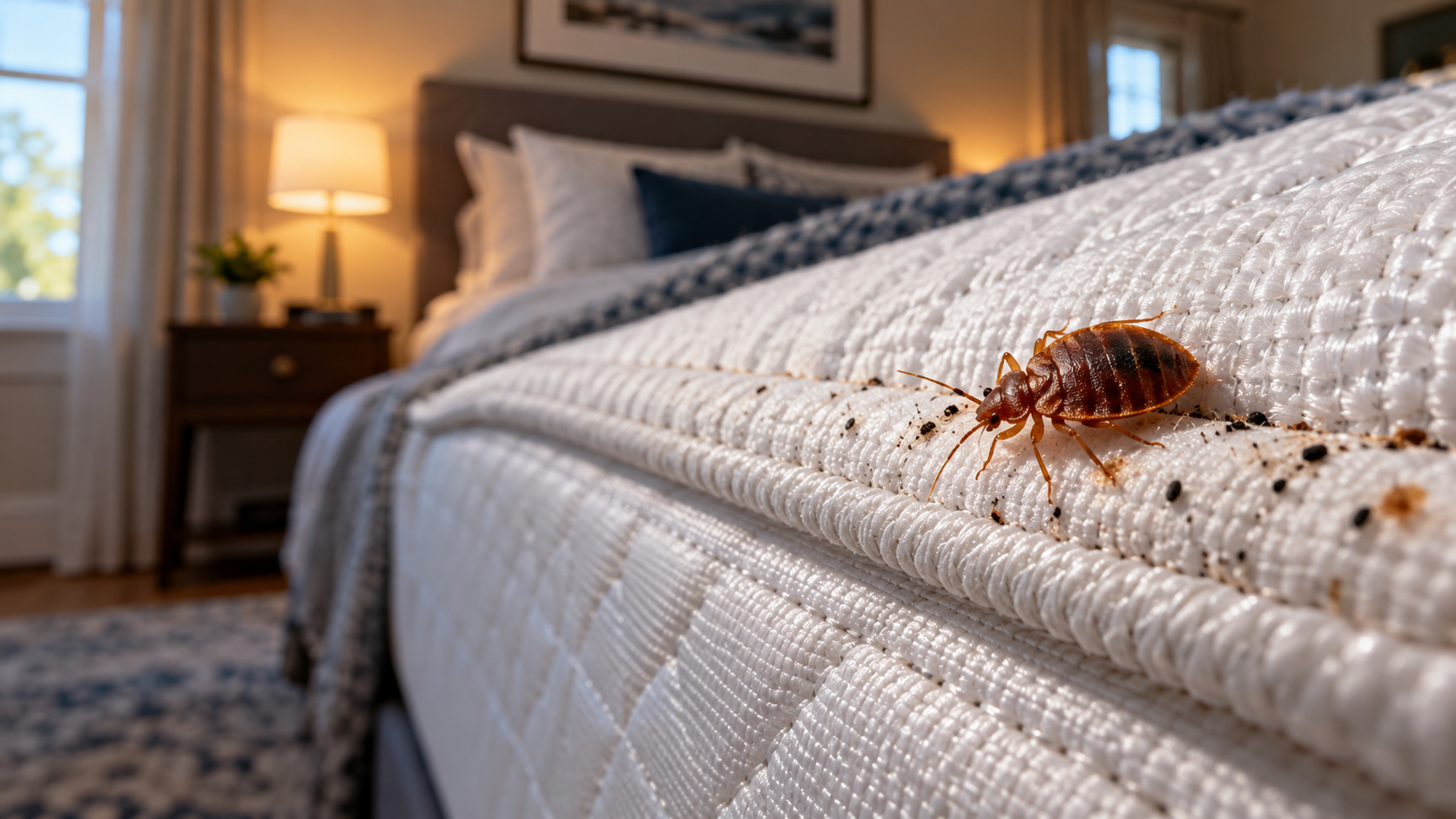
A professional inspection may look for evidence including:
- Live adult or immature bed bugs
- Bed bug eggs
- Shed skins
- Dark fecal spotting
- Activity along mattress seams and box springs
- Evidence around headboards and bed frames
- Activity in upholstered furniture
- Harborage in cracks, baseboards, trim, and nearby furniture
Property managers can learn more about identification and behavior in our Greenville bed bug guide.
3. Tell the Tenant Not to Move Belongings Into Another Unit
One of the biggest mistakes after discovering bed bugs is immediately moving mattresses, clothing, furniture, bedding, or personal belongings somewhere else.
Bed bugs are excellent hitchhikers.
Moving infested belongings through hallways, common areas, vehicles, storage rooms, or neighboring apartments can potentially move bed bugs with them.
Until the property has been evaluated, tenants should generally avoid:
- Moving furniture into hallways or neighboring units
- Giving away potentially infested furniture
- Moving into another apartment with untreated belongings
- Carrying unbagged laundry throughout the building
- Dragging mattresses or upholstered furniture through common areas
- Using multiple over-the-counter pesticides without a coordinated treatment plan
The pest management professional should provide preparation instructions based on the treatment method being used.
4. Arrange an Inspection Before the Problem Has Time to Spread
Early action can make a major difference in rental housing.
A small infestation confined to one sleeping area can be very different from an established infestation involving multiple rooms or apartments.
A professional bed bug inspection should focus on identifying:
- Whether bed bugs are actually present
- Which rooms contain evidence
- The apparent extent of the infestation
- Likely harborage areas
- Whether additional units should be evaluated
- Conditions that could interfere with treatment
D & D Pest Control Co. provides professional bed bug treatment in Greenville, NC for homes, apartments, rental properties, student housing, and other properties throughout the Greenville and Pitt County area.
5. Consider the Adjoining Units in Multi-Unit Housing
If the report involves an apartment, duplex, townhome, or other connected housing, do not automatically treat the situation as though it exists in isolation.
Depending on the building configuration and inspection findings, it may be appropriate to evaluate units sharing a:
- Wall
- Floor
- Ceiling
- Utility penetration
- Other connected structural area
This can be especially important when there is evidence suggesting an infestation is established or may have existed for some time.
Finding activity in another unit can substantially change the management strategy. Treating only one apartment while overlooking activity next door may allow the problem to continue.
6. Review North Carolina Landlord-Tenant Law Carefully
Property managers should be careful when discussing who is legally responsible for bed bug treatment in North Carolina. This article provides general educational information and is not legal advice. Responsibility can depend on the facts, the condition of the property, the lease, applicable codes, and other circumstances.
North Carolina G.S. 42-42 — Landlord Duties
North Carolina General Statute § 42-42 requires landlords to comply with applicable building and housing codes and to make repairs and do what is necessary to put and keep residential rental premises in a fit and habitable condition.
Property managers should review the current statute directly through the North Carolina General Assembly — G.S. 42-42.
North Carolina G.S. 42-43 — Tenant Duties
North Carolina law also places maintenance responsibilities on residential tenants. Under G.S. 42-43, tenants have duties that include keeping the portion of the premises they occupy and use as clean and safe as conditions permit, properly disposing of rubbish and garbage, and complying with applicable obligations imposed by building and housing codes.
Read the current statute at the North Carolina General Assembly — G.S. 42-43.
Important: An Older North Carolina Bed Bug Bill Was Proposed but Did Not Become Law
Property managers researching North Carolina bed bug laws online may encounter House Bill 721 from the 2011-2012 legislative session, titled Landlord/Tenant/Bedbug Liability.
The bill proposed specific bed bug requirements involving landlords, tenants, inspections, neighboring units, and pest-control treatment. However, property managers should not treat the proposed language in House Bill 721 as current North Carolina law.
According to the North Carolina General Assembly’s legislative history, the bill passed the North Carolina House but its last recorded action was referral to the Senate Committee on Rules and Operations of the Senate on June 10, 2011. It was not enacted into the North Carolina General Statutes.
You can review the legislative history at the North Carolina General Assembly — House Bill 721 and search current North Carolina legislative materials through the North Carolina General Assembly bed bug search.
Property-management takeaway: Do not automatically tell a tenant that North Carolina law always makes the landlord—or always makes the tenant—responsible for bed bug treatment based on the old House Bill 721 language. Review the current statutes, lease, property conditions, inspection findings, and applicable local requirements. When responsibility is disputed or the legal consequences are significant, consult a North Carolina attorney familiar with residential landlord-tenant law.
7. Review the Lease—but Don’t Let the Lease Replace an Investigation
After receiving the complaint, review the property’s current lease and pest-control provisions.
Look for provisions addressing:
- Pest reporting requirements
- Tenant sanitation responsibilities
- Access for inspections and pest-control service
- Treatment preparation requirements
- Unauthorized or used furniture
- Responsibility for damage caused by tenant conduct
- Property-management procedures for pest complaints
A lease provision by itself does not determine every legal question. Property managers should avoid assigning blame before gathering the relevant facts.
8. Give the Tenant Written Bed Bug Preparation Instructions
Successful bed bug control requires cooperation.
Depending on the treatment program, preparation may include instructions concerning:
- Laundering and drying bedding and clothing
- Bagging cleaned belongings
- Reducing excessive clutter
- Providing access around beds and furniture
- Handling mattresses and box springs
- Vacuuming designated areas
- Keeping treated belongings separated from untreated items
- Preparing pets or occupants for the treatment period
- Following re-entry instructions
Do not give every tenant a generic internet checklist without first coordinating it with the pest-control company. Preparation requirements can differ depending on the treatment method and conditions inside the property.
9. Avoid Uncoordinated DIY Spraying
A tenant discovering bed bugs at midnight may immediately reach for a household insecticide. A property manager may also be tempted to spray the room and consider the problem handled.
That approach can complicate an infestation.
Bed bugs hide in extremely small protected spaces, and successful management may require inspection, targeted treatment, monitoring, preparation, and follow-up rather than simply applying pesticide to visible insects.
Property managers should also discourage tenants from using products contrary to their labels or applying pesticides in ways that could create unnecessary exposure.
10. Create a Unit-by-Unit Treatment Record
Documentation becomes increasingly important when managing multiple rental units.
For each reported infestation, consider maintaining records of:
- Original tenant complaint
- Inspection date
- Units inspected
- Inspection findings
- Photographs when appropriate
- Preparation instructions supplied to the tenant
- Treatment dates
- Products or methods documented by the pest-control provider
- Follow-up inspection or treatment dates
- Tenant communications
- Final monitoring results
This creates a history that can be particularly useful for apartment communities, student rentals, property-management portfolios, and properties experiencing repeat pest complaints.
11. Schedule Follow-Up Instead of Assuming One Treatment Solved Everything
Bed bug management should be based on results, not assumptions.
Bed bug eggs, hidden harborages, untreated belongings, heavy clutter, missed activity, or movement between units can make follow-up necessary.
A property manager should know:
- When the initial treatment was performed
- Whether another visit is scheduled
- What the tenant should monitor
- What signs should be reported immediately
- Whether adjoining units require additional evaluation
- When the pest-control provider considers the treatment process complete
12. Build Bed Bug Procedures Into Your Greenville Property-Management Plan
The best time to create a bed bug response policy is before the next complaint arrives.
A written property-management procedure can establish who receives the complaint, how quickly it is documented, who contacts pest control, how residents receive preparation instructions, how adjoining units are handled, and where inspection and treatment records are stored.
For broader pest prevention at rentals, see our guide to pest control services for Greenville rental properties and property managers.
Bed Bugs and Greenville’s Rental Housing
Greenville has a diverse rental market that includes single-family rental homes, apartments, duplexes, townhomes, student housing, and properties serving people connected with East Carolina University and the surrounding community.
Properties with frequent move-ins and move-outs require particular attention because bed bugs can be introduced with personal belongings without anyone realizing they are present.
A practical turnover process may include:
- Inspecting bedrooms after move-out
- Checking mattress or furniture left behind
- Examining baseboards and bed areas for suspicious spotting
- Documenting existing pest conditions
- Removing abandoned belongings appropriately
- Addressing confirmed pest problems before the next tenant occupies the unit
Bed bugs are not automatically evidence of poor housekeeping. Because they are hitchhiking insects, they can be introduced into well-maintained properties as well as cluttered ones. Clutter, however, can create additional hiding places and make inspection and treatment more difficult.
Quick Bed Bug Response Checklist for Greenville Property Managers
- Document the complaint.
- Ask the tenant not to move potentially infested belongings to another unit.
- Arrange for identification and inspection.
- Determine which rooms show evidence of activity.
- Consider adjoining units when dealing with connected housing.
- Review the lease and current North Carolina landlord-tenant requirements.
- Provide treatment-specific preparation instructions.
- Coordinate professional treatment when appropriate.
- Document inspections, treatment, communication, and follow-up.
- Monitor the property until the issue has been resolved.
Frequently Asked Questions About Bed Bugs in Greenville Rental Properties
Who pays for bed bug treatment in a North Carolina rental property?
There is not a simple universal answer that should be applied to every infestation. Responsibility can depend on the circumstances, current North Carolina law, the lease, property conditions, applicable housing requirements, and the facts surrounding the infestation. Property managers should be especially cautious about websites quoting North Carolina House Bill 721 from 2011 as though its proposed bed bug provisions became law; the bill did not complete the legislative process.
Should a property manager inspect apartments beside an infested unit?
In connected or multi-unit housing, evaluating nearby units may be an important part of determining the extent of an infestation. The appropriate inspection scope depends on the building configuration, severity of activity, and professional findings.
Should a tenant throw away an infested mattress?
Not automatically. Discarding a mattress does not necessarily eliminate an infestation because bed bugs may also be present in the bed frame, furniture, baseboards, cracks, or other areas. Moving an untreated mattress through a building can also spread bed bugs. Ask the pest-control professional how the item should be handled.
Can a tenant treat bed bugs with store-bought sprays?
Uncoordinated pesticide applications may fail to reach hidden harborages and can interfere with a professional treatment strategy. Pesticides should always be used according to their labels. For an established infestation, professional evaluation is generally the more reliable starting point.
Do bed bugs mean the tenant’s apartment is dirty?
No. Bed bugs primarily spread by hitchhiking on belongings and can occur in clean properties. Excessive clutter can make an infestation harder to locate and treat, but cleanliness alone does not determine whether a property can get bed bugs.
Can bed bugs spread from one apartment to another?
Yes. Bed bugs can be carried between apartments on personal belongings, furniture, clothing, and other items. In connected structures, movement between adjoining areas is also possible, which is why multi-unit infestations require careful evaluation.
How quickly should a Greenville property manager respond?
A suspected infestation should be addressed promptly. Delaying inspection gives an established population additional time to reproduce or potentially spread. Document the report, communicate with the tenant, and begin the inspection process as soon as reasonably possible.
Professional Bed Bug Treatment for Greenville Property Managers
Managing bed bugs across rental properties requires more than killing the insects that happen to be visible on inspection day. Successful control depends on identifying the infestation, understanding where activity is occurring, coordinating with occupants, using an appropriate treatment strategy, and following up when necessary.
D & D Pest Control Co. provides professional pest-control services for rental properties, apartments, property managers, homeowners, and businesses in Greenville and the surrounding Pitt County area.
For an active infestation, visit our Bed Bug Treatment in Greenville, NC page.
For ongoing rental-property pest management, visit our Pest Control Service in Greenville, NC page.
Office: (252) 523-8255
Manager: (252) 531-0621
Service Area: Greenville, Pitt County, and surrounding Eastern North Carolina communities
Contact D & D Pest Control Co. to request bed bug service for a Greenville rental property.
North Carolina Bed Bug & Landlord-Tenant Resources
- North Carolina General Statute § 42-42 — Landlord to Provide Fit Premises
- North Carolina General Statute § 42-43 — Tenant to Maintain Dwelling Unit
- Search North Carolina General Assembly Materials for “Bed Bugs”
- 2011 House Bill 721 — Landlord/Tenant/Bedbug Liability Legislative History
- U.S. Environmental Protection Agency — Bed Bug Information
Legal Disclaimer: This page is intended for general educational and pest-management information and is not legal advice. North Carolina statutes, regulations, housing codes, lease provisions, and individual circumstances may affect landlord and tenant responsibilities. Property owners and managers should consult qualified legal counsel when determining legal responsibility or taking action based on a particular tenancy.