Professional German Cockroach Baiting and Treatment in Greenville, Pitt County & Eastern North Carolina
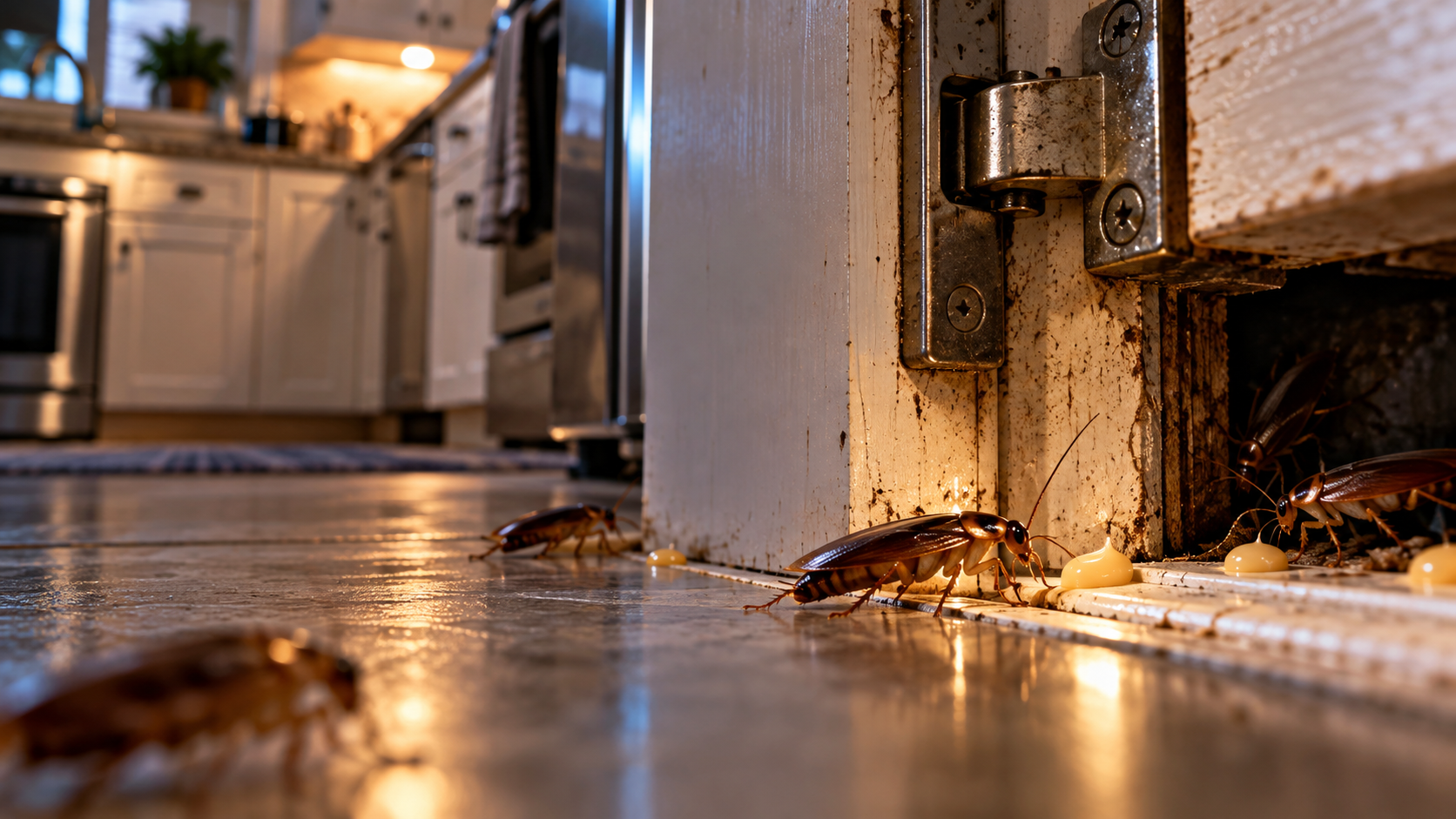
German cockroaches are among the most persistent and difficult indoor pests to eliminate. Whether they are hiding behind a refrigerator in a Greenville home, multiplying inside an apartment complex near East Carolina University, or spreading through a commercial kitchen in Pitt County, these insects can establish large infestations before property owners recognize the extent of the problem.
One of the most effective methods for controlling German cockroaches is professional gel baiting. Unlike traditional pesticide spraying, which primarily targets insects exposed to treated surfaces, gel baits encourage cockroaches to consume an insecticide-containing food source placed near their hiding and feeding areas.
However, not all cockroach baits work the same way. Different products contain different active ingredients, attractants, food formulations, and insecticide modes of action. Some products are designed for professional use, while others are available to homeowners.
Understanding these differences is essential when deciding how to treat a German cockroach infestation.
At D & D Pest Control Co., we emphasize inspection-based pest management, targeted treatment, sanitation recommendations, and follow-up monitoring for residential and commercial properties throughout Eastern North Carolina.
Why German Cockroaches Are So Difficult to Eliminate
The German cockroach (Blattella germanica) is a small, light-brown insect identified by two dark parallel stripes located behind its head.
Unlike larger cockroach species that frequently live outdoors, German cockroaches are primarily indoor pests. They depend on buildings for food, shelter, warmth, and moisture.
Their preferred hiding locations include:
- Behind refrigerators, freezers, and stoves
- Under kitchen sinks and dishwashers
- Inside cabinet joints and narrow crevices
- Behind loose wall coverings and baseboards
- Around plumbing penetrations
- Near commercial kitchen equipment
- Inside protected appliance compartments
- In bathrooms, laundry rooms, and utility spaces
- Around coffee makers, microwaves, and other warm appliances
German cockroaches reproduce rapidly. A female may carry an egg capsule containing approximately 30–40 eggs, allowing an established infestation to expand quickly when conditions are favorable.
Their ability to hide in extremely narrow spaces makes them particularly challenging to control with ordinary household sprays.
Even when visible cockroaches disappear, others may remain concealed inside cabinets, equipment, and structural openings.
Effective German cockroach treatment must address the hidden population, not just the insects visible on countertops or floors.
Learn more about identifying infestations in our German Cockroach Identification and Control Guide.
What Is German Cockroach Gel Baiting?
German cockroach gel baiting involves placing small quantities of specially formulated insecticidal bait where cockroaches are actively feeding, traveling, or hiding.
A typical gel bait contains three major components:
- An insecticide active ingredient designed to kill cockroaches after exposure.
- Food-based attractants and feeding stimulants that encourage cockroaches to consume the bait.
- A gel carrier that holds the ingredients together and allows precise placement.
Instead of treating large exposed surfaces, technicians can place bait inside suitable cracks, crevices, and other protected locations identified during an inspection.
The cockroach consumes the bait and receives a lethal dose of the active ingredient.
Depending on the formulation, the insecticide may interfere with the insect’s nervous system or another essential biological process.
Some bait formulations also contribute to secondary mortality, meaning cockroaches that did not directly consume the original bait may be exposed through interactions with contaminated feces or the bodies of affected cockroaches.
This makes baiting particularly valuable for a species that spends much of its life hidden from view.
What NC State Extension Says About German Cockroach Baiting
According to NC State Extension’s German Cockroach Surveillance and Management guide, gel baiting is among the most effective approaches to German cockroach control.
The publication, authored by researchers and specialists at North Carolina State University, identifies insecticidal baits as an important component of successful German cockroach management.
NC State Extension explains that professional pest management companies have access to multiple bait formulations, including gels, pastes, dry flowables, and enclosed bait stations.
The guide also emphasizes that successful cockroach control depends on several factors:
- Placing bait close to cockroach hiding locations
- Using multiple appropriately sized placements
- Reducing competing food sources
- Monitoring the infestation after treatment
- Replenishing bait when necessary
- Avoiding repellent insecticides near bait applications
- Recognizing insecticide resistance and bait aversion
One particularly important recommendation concerns bait placement.
Rather than concentrating a large amount of bait in one area, numerous small placements near cockroach harborages generally provide better opportunities for insects to encounter and consume the product.
This approach can also limit unnecessary pesticide exposure when carried out according to the product label.
The goal of professional gel baiting is not to apply the greatest amount of insecticide. It is to place the appropriate bait where cockroaches are most likely to feed on it.
How German Cockroach Gel Baits Work
Gel bait treatment works through a sequence of biological and behavioral interactions.
Step 1: Cockroaches Encounter the Bait
German cockroaches spend substantial amounts of time inside protected hiding places.
They typically emerge to search for food and water, often during nighttime hours.
When gel bait is placed near active harborages or travel routes, cockroaches may encounter it while foraging.
Gel baits do not normally attract cockroaches from across an entire building. Strategic placement near existing activity is essential.
Step 2: The Cockroach Consumes the Bait
The bait contains ingredients that encourage feeding.
Once the cockroach eats a sufficient amount, the insecticide begins affecting its biological functions.
Different active ingredients work at different rates.
Some formulations may cause mortality relatively quickly, while others act more gradually.
The actual outcome depends on the product, the amount consumed, the susceptibility of the cockroach population, and environmental conditions.
Step 3: Secondary Transfer May Affect Additional Cockroaches
German cockroaches display several feeding behaviors that can contribute to insecticide transfer.
These include:
Coprophagy: Feeding on the feces of other cockroaches.
Necrophagy: Feeding on dead cockroaches.
Cannibalism: Feeding on members of the same species.
Certain bait formulations can produce secondary mortality when other cockroaches consume contaminated material.
Research published in the Journal of Economic Entomology has demonstrated secondary transfer involving several cockroach bait active ingredients.
Read the research: Cockroaches as Trojan Horses for Control of Cockroach Aggregations With Baits.
Secondary transfer is a useful advantage of some gel baits, but it does not occur equally with every formulation or guarantee that all cockroaches will be eliminated.
Step 4: The Population Begins to Decline
As more cockroaches consume bait, the population can decline.
However, a decrease in visible cockroaches does not necessarily mean the infestation has been eliminated.
Egg capsules may remain, surviving insects may continue breeding, and some individuals may not encounter the bait.
For this reason, professional pest management should include continued monitoring and additional treatment when necessary.
Types of German Cockroach Baits Available on the Market
There are several major categories of cockroach bait products used in residential and commercial pest management.
Each has advantages and limitations.
1. Gel Cockroach Baits
Gel baits are commonly supplied in syringe-style applicators or cartridges used with specialized bait guns.
They allow precise placement near cockroach hiding areas.
Advantages:
- Can be placed close to cockroach harborages
- Useful for narrow cracks and crevices
- Available with several different active ingredients
- Can reduce the need for widespread surface spraying
- Suitable for many residential and commercial applications when labeled
Limitations:
- May dry out or harden over time
- Can become contaminated by grease, dust, or cleaning products
- May not be consumed by bait-averse cockroaches
- Requires accurate inspection and placement
- Can be affected by competing food sources
- Must be kept away from children, pets, food, and food-contact surfaces according to the label
Gel bait is often a preferred option for treating established German cockroach infestations.
2. Cockroach Bait Stations
Bait stations are enclosed containers holding insecticidal bait.
They are widely available at retail stores and through professional pest control suppliers.
Advantages:
- Keep bait contained within a designated station
- May reduce access to bait when properly installed
- Convenient for homeowners
- Can provide extended bait availability
- Useful where exposed gel placements would be inappropriate
Limitations:
- May not fit close enough to some cockroach hiding areas
- Placement options are more limited than with gel applicators
- Cockroaches must enter the station and consume the bait
- Stations may become depleted, contaminated, or less attractive
- Heavily infested properties may require additional treatment methods
Bait stations can be useful, but their effectiveness depends heavily on placement and cockroach activity.
3. Dry Flowable Cockroach Baits
Dry flowable baits contain insecticidal ingredients in a dry formulation intended for use in appropriate protected locations.
An example documented in University of Florida Extension research is Avert Dry Flowable, which contains abamectin.
Advantages:
- Provide an alternative to gel formulations
- May be suitable for certain protected areas
- Can offer another active ingredient or bait matrix within a control program
Limitations:
- Product labels restrict application sites and methods
- Loose material can become displaced or contaminate unintended surfaces
- Not appropriate for exposed food-contact areas
- Must not be confused with ordinary insecticidal dusts
Professional selection and careful application are particularly important.
4. Granular Cockroach Baits
Granular baits consist of insecticide combined with a solid food-based carrier.
Some formulations are designed for specific cockroach species or treatment environments.
Advantages:
- Alternative feeding matrix for some populations
- Certain protein-based formulations may help when cockroaches reject sweeter baits
- Some products are useful in specialized commercial or structural applications
Limitations:
- Not every granular product is labeled for indoor German cockroach treatment
- Loose granules can be scattered
- Placement near food preparation surfaces may be restricted
- Product effectiveness varies by formulation and cockroach feeding behavior
The NC State Extension guide discusses protein-based bait alternatives when glucose aversion is suspected.
5. Boric Acid Cockroach Baits
Certain cockroach bait products use boric acid as an active ingredient.
Boric acid may be incorporated into gel or other food-based bait formulations.
Advantages:
- Offers an alternative active ingredient
- May be useful in certain integrated pest management programs
- Has a different mode of action from many conventional neurotoxic insecticides
Limitations:
- Generally slower acting than some other bait ingredients
- Effectiveness depends on cockroaches consuming the formulation
- Can be less effective when more attractive food is available
- Excessive concentrations or unsuitable formulations may discourage feeding
- Boric acid products are still pesticides and require label-compliant use
Important: Boric acid bait is not the same product as loose boric acid insecticidal dust. Their formulations, application methods, and labeled uses may differ.
Common Professional German Cockroach Gel Baits and Active Ingredients
Professional cockroach control companies may select from several bait products and insecticide chemistries.
Examples documented by the University of Florida’s Assessment-Based Pest Management of German Cockroaches include the following.
| Product example | Active ingredient | General characteristics |
|---|---|---|
| Advion Cockroach Gel | Indoxacarb | Sodium-channel-blocking insecticide used in gel bait formulations |
| Maxforce FC and related formulations | Fipronil | Nervous-system-targeting insecticide |
| Alpine Cockroach Gel | Dinotefuran | Neonicotinoid insecticide used in specialized cockroach gel formulations |
| Vendetta Cockroach Gel | Abamectin | Avermectin insecticide with a different mode of action |
| InVict Gold Cockroach Gel | Imidacloprid | Neonicotinoid-based gel bait |
| Maxforce Impact | Clothianidin | Neonicotinoid-based cockroach bait |
| Vendetta Plus | Abamectin and pyriproxyfen | Combines an insecticide with an insect growth regulator |
| InTice Roach Bait | Boric acid | Borate-based bait formulation |
These products are examples of formulations documented in university research, not a ranking or endorsement. Product formulations, registrations, availability, and permitted uses can change. Always verify the current EPA-approved label and North Carolina registration before selecting or applying a product.
Understanding Active Ingredients
The active ingredient determines how the pesticide affects the insect.
However, two products containing the same active ingredient may perform differently because of differences in attractants, moisture content, bait consistency, and other formulation characteristics.
A bait can contain an effective insecticide and still perform poorly if cockroaches refuse to eat it.
This is one reason professional pest control requires more than choosing a recognizable product name.
Why German Cockroach Gel Baits Sometimes Fail
Although gel baiting is highly effective when properly used, it has several important limitations.
1. Insecticide Resistance
German cockroaches can develop resistance to insecticides.
Resistance occurs when a cockroach population becomes less susceptible to an active ingredient, allowing more individuals to survive exposure.
Repeated reliance on insecticides with the same mode of action can contribute to resistance selection.
For example, rotating between two products with different names but the same insecticide mode of action may not provide meaningful resistance management.
Professional pest management programs should evaluate the active ingredients and their classifications rather than relying only on brand names.
Information about insecticide mode-of-action groups is available through the Insecticide Resistance Action Committee.
2. Glucose Aversion and Bait Rejection
One of the most interesting developments in German cockroach research involves behavioral resistance.
Some German cockroach populations have developed an aversion to glucose, a sugar used in certain bait formulations.
Instead of recognizing glucose as an appealing food component, these cockroaches may perceive it as unpleasant and avoid consuming the bait.
This condition is known as glucose aversion.
It is especially important because a bait cannot control cockroaches effectively when the target population refuses to eat it.
Changing the active ingredient alone may not solve the problem if the replacement product contains a similarly unattractive food formulation.
When bait aversion is suspected, a professional may evaluate alternative bait matrices, including protein-based products, and review other reasons for poor feeding.
NC State Extension specifically discusses glucose aversion and the potential role of protein-based bait alternatives.
3. Applying Too Much Bait in One Location
More bait does not automatically mean better control.
Large deposits may be unnecessary, more exposed to contamination, or poorly positioned relative to cockroach movement.
Numerous smaller placements, applied according to the label, generally provide better coverage of cockroach activity areas.
However, heavy infestations may consume substantial amounts of bait and require replenishment.
The objective is adequate bait availability in suitable locations, not indiscriminate overapplication.
4. Bait Drying Out
Gel formulations can lose moisture over time.
Heat, airflow, dust, and environmental conditions may affect the consistency and attractiveness of bait deposits.
A gel that has become hardened or contaminated may need replacement.
Freshness and continued bait consumption should be evaluated during follow-up inspections.
5. Competing Food Sources
German cockroaches are opportunistic feeders.
If they have easy access to grease, crumbs, pet food, garbage, and spilled liquids, they may be less likely to consume insecticidal bait.
Common sanitation problems include:
- Grease accumulation behind cooking equipment
- Food residue beneath refrigerators
- Dirty dishes left overnight
- Open trash containers
- Pet food left accessible
- Food debris inside cabinet joints
- Uncleaned spills behind commercial kitchen equipment
- Excessive cardboard storage
Sanitation improvements reduce competing food sources and help maximize the effectiveness of baiting.
6. Applying Repellent Sprays Near Bait
Applying repellent insecticides directly over or near cockroach bait can interfere with feeding.
Certain sprays may cause cockroaches to avoid treated locations.
The result can be reduced bait consumption and potentially greater difficulty controlling the infestation.
For this reason, NC State Extension advises against spraying insecticides in areas where cockroach bait has been applied.
Targeted sprays may still have a role in professional pest management when compatible with the bait program and permitted by the relevant labels.
7. Egg Capsules and Newly Hatched Cockroaches
Cockroach bait does not necessarily kill eggs protected inside an egg capsule.
Female German cockroaches carry egg capsules until shortly before hatching.
Following the initial treatment, newly hatched cockroaches may become active.
Continued bait availability and monitoring help address newly emerging individuals.
Heavily infested properties may require multiple visits before the population is adequately controlled.
8. Incorrect Identification or Placement
Different cockroach species behave differently.
German cockroaches primarily reproduce indoors, while some larger species may originate outdoors or in other parts of a structure.
A treatment program designed for German cockroaches may not be appropriate for a different cockroach species.
Proper identification and inspection should occur before treatment.
Gel Baiting vs. Spraying, Fogging, and Dusting
Property owners often ask whether gel baiting is better than traditional spraying or fogging.
The answer depends on the pest species, infestation conditions, and treatment objective.
| Treatment method | Advantages | Important limitations |
|---|---|---|
| Gel baiting | Targets feeding cockroaches near harborages and may provide secondary transfer | Requires consumption, good placement, and monitoring |
| Crack-and-crevice spraying | Can target selected hiding spaces | Repellent products may interfere with baiting; resistance can reduce effectiveness |
| Total-release foggers | Disperse insecticide into exposed areas | Generally ineffective for German cockroach infestations because hidden harborages are not adequately reached |
| Insecticidal dusting | Can provide residual activity in suitable protected voids | Improper or excessive application increases contamination and exposure risks |
| Insect growth regulators | Can interfere with development and reproduction | Usually supplemental; not a substitute for eliminating established adults |
| Sanitation and exclusion | Reduce food sources, shelter, and reinfestation opportunities | Severe infestations often require additional control measures |
Why Foggers Are Usually a Poor Choice
Total-release foggers, commonly called bug bombs, are frequently purchased by homeowners attempting to eliminate German cockroaches.
However, NC State Extension explains that these products are ineffective for German cockroach control because they generally fail to penetrate the narrow spaces where cockroaches hide and reproduce.
Foggers can also create exposure and fire hazards.
For German cockroach infestations, targeted baiting, inspection, sanitation, and monitoring are generally more appropriate than relying on foggers.
Are Organic or Natural German Cockroach Baits Effective?
Some property owners in Greenville and Pitt County prefer natural, organic, or lower-exposure pest management approaches.
It is important to distinguish between natural ingredients, certified organic products, and pesticide formulations marketed as environmentally friendly.
These terms do not mean the same thing.
Boric Acid Baits
Boric acid has a long history of use in insect control.
Certain commercial bait formulations use boric acid as their active ingredient.
Although boric acid can be effective under appropriate conditions, it remains a pesticide and can pose exposure risks when misused.
Diatomaceous Earth
Diatomaceous earth is generally used as an insecticidal dust rather than a food-based gel bait.
Certain pesticide-labeled formulations can damage the protective outer layer of insects, contributing to dehydration.
Its effectiveness depends on proper application and contact.
It should not be placed where airborne dust could contaminate food, equipment, or occupied areas.
Only products specifically labeled for insect control should be used.
Essential Oils and Botanical Products
Some botanical ingredients have demonstrated insecticidal or repellent activity under laboratory conditions.
However, laboratory effects do not necessarily translate into reliable elimination of established German cockroach infestations inside occupied buildings.
Essential-oil products may provide temporary effects, but they should not automatically be considered substitutes for proven bait-based treatment programs.
Botanical ingredients can also cause irritation or other adverse effects and must be used according to their labels.
An Integrated Pest Management Alternative
For property owners seeking to reduce unnecessary pesticide use, Integrated Pest Management (IPM) is often a more practical approach than relying on products marketed as natural.
IPM emphasizes:
- Correct pest identification
- Detailed inspections
- Sanitation
- Moisture reduction
- Removal of hiding places
- Exclusion and structural repairs
- Targeted use of appropriately selected pesticides
- Monitoring and treatment adjustments
Learn more through the University of California Integrated Pest Management Program.
Why Sanitation Is Essential During German Cockroach Baiting
Successful cockroach treatment requires cooperation between the pest management professional and the property occupant.
Even highly effective bait formulations may perform poorly when cockroaches have abundant competing food and water.
Property owners should focus on correcting the conditions that support infestations.
Recommended Sanitation Practices
- Clean kitchen countertops and food preparation areas after use.
- Remove accumulated grease from accessible areas around appliances.
- Store food in tightly sealed containers.
- Empty garbage regularly.
- Repair leaking faucets and plumbing.
- Avoid leaving pet food accessible overnight.
- Remove unnecessary cardboard boxes and clutter.
- Clean behind refrigerators and stoves where safely accessible.
- Report plumbing leaks and recurring moisture problems.
- Follow the pest control company’s treatment preparation instructions.
Important: Do not scrub away, cover, spray, or disturb professionally applied bait placements. Ask your technician which areas can be cleaned and which treated locations should remain undisturbed.
German Cockroach Gel Baiting for Greenville Rental Properties and Apartments
German cockroaches can be especially difficult to control in apartment buildings, duplexes, student housing, and other multifamily properties.
These buildings may contain shared plumbing lines, wall cavities, utility penetrations, and adjoining kitchens.
Cockroaches may move between units through structural openings.
Treating only the apartment where cockroaches are visible may not adequately control a building-wide problem.
Property managers should consider:
- Inspecting neighboring units when conditions indicate possible spread
- Coordinating access for treatments
- Addressing sanitation and maintenance issues
- Repairing plumbing leaks
- Sealing appropriate structural openings
- Tracking recurring complaints
- Scheduling follow-up inspections when needed
These considerations are especially relevant to Greenville rental properties serving East Carolina University students and other residents throughout Pitt County.
Professional German Cockroach Baiting for Greenville Restaurants
Restaurants, cafeterias, commercial kitchens, food-service establishments, and hospitality properties face additional challenges.
Food preparation areas provide warmth, moisture, grease, and numerous hiding places.
Cockroaches may establish activity around:
- Commercial refrigerators
- Cooking equipment
- Dishwashing areas
- Food storage rooms
- Beverage stations
- Plumbing penetrations
- Floor-wall junctions
- Equipment compartments
Commercial cockroach control must also consider food safety and pesticide-label restrictions.
Gel bait applications should never contaminate food, food-contact surfaces, utensils, or other prohibited areas.
Products must be approved for the specific treatment site and applied according to applicable directions.
For commercial facilities, successful treatment generally requires ongoing coordination between management, cleaning personnel, and pest management professionals.
Why Professional Pest Control May Be More Effective Than DIY Baiting
Over-the-counter bait products can be useful in some situations.
However, heavily established German cockroach infestations often require a more comprehensive approach.
Professional pest management provides additional advantages through:
Accurate identification: Determining the cockroach species and identifying the most active areas.
Treatment assessment: Evaluating sanitation, structural conditions, and infestation severity.
Product selection: Choosing appropriate bait formulations and modes of action.
Precise placement: Applying bait near active hiding and feeding locations rather than relying on random treatment.
Resistance management: Considering product history, possible resistance, and bait rejection.
Integrated treatment: Using complementary control measures when appropriate.
Follow-up monitoring: Evaluating whether activity has declined and whether additional treatment is necessary.
Not every infestation requires the same treatment program.
A small residential infestation may need a different approach from a restaurant, heavily infested apartment building, or commercial food-storage facility.
For more information, visit our Professional German Cockroach Treatment Services.
How Long Does German Cockroach Gel Baiting Take to Work?
Cockroach gel baiting is not an instant treatment.
Some cockroaches may die within a relatively short period after consuming an effective bait, but reducing an established population generally takes longer.
University extension research indicates that noticeable reductions may take seven days or longer, depending on conditions.
The overall treatment period can vary based on:
- Initial population size
- Active ingredient and bait formulation
- Cockroach susceptibility
- Quantity of bait consumed
- Infestation locations
- Sanitation conditions
- Availability of competing food
- Egg hatching and reproduction
- Movement between adjoining units
- Follow-up treatment and monitoring
Heavy infestations can require repeated applications and several weeks or longer of management.
The most reliable way to measure progress is to combine inspection findings with monitoring devices and documented cockroach activity.
Seeing fewer insects is encouraging, but continued monitoring is necessary to determine whether the infestation has been adequately controlled.
Frequently Asked Questions About German Cockroach Gel Baiting
What is the most effective bait for German cockroaches?
There is no single bait product that is universally most effective for every German cockroach population.
Effectiveness depends on the active ingredient, food formulation, placement, resistance, bait aversion, and environmental conditions.
Professional gel baits containing indoxacarb, fipronil, dinotefuran, abamectin, and other registered ingredients are among the available options.
Does German cockroach gel bait kill the entire infestation?
A well-designed baiting program can achieve substantial population reductions and may eliminate an infestation.
However, results depend on whether cockroaches consume sufficient bait, whether eggs continue to hatch, and whether the property is subject to reinfestation.
Follow-up monitoring is important.
Can German cockroaches become resistant to gel bait?
Yes. German cockroach populations can develop insecticide resistance.
Some populations also exhibit behavioral bait aversion, including glucose aversion.
Professional treatment decisions should consider both the active ingredient and the bait’s food formulation.
Should I spray cockroaches after applying gel bait?
Do not automatically spray areas where gel bait has been applied.
Repellent insecticides can interfere with bait consumption.
Always follow pesticide labels and the instructions provided by the pest management professional.
Why are cockroaches still appearing after treatment?
Continued sightings can occur because cockroaches remain in protected harborages, newly hatched individuals have emerged, or some insects have not yet consumed bait.
Ongoing activity may also indicate competing food sources, resistance, poor bait placement, or movement from neighboring units.
Persistent activity should prompt reassessment rather than repeated indiscriminate spraying.
Do cockroach gel baits attract more cockroaches into my home?
Cockroach gel bait is intended to encourage nearby cockroaches to feed.
It does not normally attract German cockroaches from distant buildings or outdoor environments.
Its effectiveness depends on locating bait near an existing population.
Is gel baiting safe around children and pets?
Targeted baiting can limit widespread insecticide application, but insecticidal bait is not harmless.
Products must be placed only where the label permits and kept inaccessible to children and pets.
A licensed pest control professional can evaluate suitable treatment locations.
Can gel bait be used in restaurant kitchens?
Certain registered bait formulations are labeled for appropriate commercial food-handling environments.
However, application restrictions are important.
Baits must not contaminate food or food-contact surfaces, and application must comply with the specific product label and applicable regulations.
Is professional gel baiting better than using bug bombs?
For German cockroaches, targeted baiting is generally more effective than total-release foggers.
Foggers typically fail to reach many of the narrow spaces where German cockroaches live and breed.
Do I need to clean my home before treatment?
Removing competing food sources is strongly recommended.
However, avoid disturbing established bait placements or applying household cleaning chemicals directly over treated areas.
Follow the preparation and aftercare recommendations provided by your pest control technician.
Professional German Cockroach Control in Greenville, NC and Pitt County
German cockroach infestations rarely resolve without addressing the conditions that allow them to survive.
Simply spraying visible cockroaches may provide temporary relief while leaving hidden populations untouched.
Professional baiting offers a more targeted approach by placing insecticidal food sources near active cockroach harborages.
When combined with detailed inspections, appropriate product selection, sanitation improvements, resistance management, and follow-up monitoring, gel baiting can be a powerful tool for controlling difficult German cockroach infestations.
At D & D Pest Control Co., we provide professional pest management services for homes, apartments, rental properties, restaurants, and commercial buildings throughout Eastern North Carolina.
Our service areas include Greenville, Winterville, Ayden, Grifton, Kinston, Snow Hill, New Bern, Goldsboro, and surrounding communities.
We understand that every German cockroach infestation is different.
Our objective is to identify the conditions supporting the infestation and recommend a treatment strategy appropriate for the property.
Schedule Professional German Cockroach Treatment
Don’t let a few German cockroaches become a serious infestation.
If you are seeing German cockroaches in your kitchen, rental property, restaurant, or commercial building, contact D & D Pest Control Co. to discuss your pest control needs.
D & D Pest Control Co. — Serving Eastern North Carolina Since 1994
North Carolina Structural Pest Control License #1274 PW
Office: (252) 523-8255
Website: www.ddpestcontrol.com
Professional German Cockroach Services: German Cockroach Treatment
Professional Pest Control • German Cockroach Baiting • Residential & Commercial Pest Management
Research and Educational References
The following university and government resources provide additional information about German cockroach biology, baiting, pesticide resistance, and integrated pest management.
- NC State Extension — German Cockroach Surveillance and Management
https://content.ces.ncsu.edu/german-cockroach-surveillance-management - University of Florida IFAS Extension — Assessment-Based Pest Management of German Cockroaches
https://ask.ifas.ufl.edu/publication/in1190 - University of California — Cockroaches: Integrated Pest Management
https://ipm.ucanr.edu/home-and-landscape/cockroaches/ - Rutgers Cooperative Extension — German Cockroach
https://njaes.rutgers.edu/fs1322/ - Insecticide Resistance Action Committee — Insecticide Mode of Action Classification
https://irac-online.org/ - Peer-Reviewed Research — Cockroaches as Trojan Horses for Control of Cockroach Aggregations With Baits
https://pubmed.ncbi.nlm.nih.gov/36734002/
Educational disclaimer: Treatment recommendations and pesticide examples are provided for general information. Pesticide applications must comply with current EPA-approved labels, North Carolina requirements, and all applicable safety restrictions. Mention of commercial products does not constitute an endorsement or guarantee of effectiveness.
#Apartment Cockroach Treatment #Cockroach Bait Resistance #Cockroach Exterminator Greenville NC #Cockroach Gel Baits #Commercial Cockroach Control #D & D Pest Control Co. #Eastern North Carolina pest control #German Cockroach Control #German Cockroach Gel Baiting #German Cockroach Treatment #German Roach Bait #German Roach Infestation #Glucose Aversion Cockroaches #Greenville NC pest control #integrated pest management #Pitt County pest control #Restaurant Pest Control
Related Posts
 VA & FHA Wood Destroying Insect Reports in Greenville, NC | Pitt County Termite Inspections
 Bed Bugs on the Rise? What Greenville, NC Homeowners Need to Know in 2026