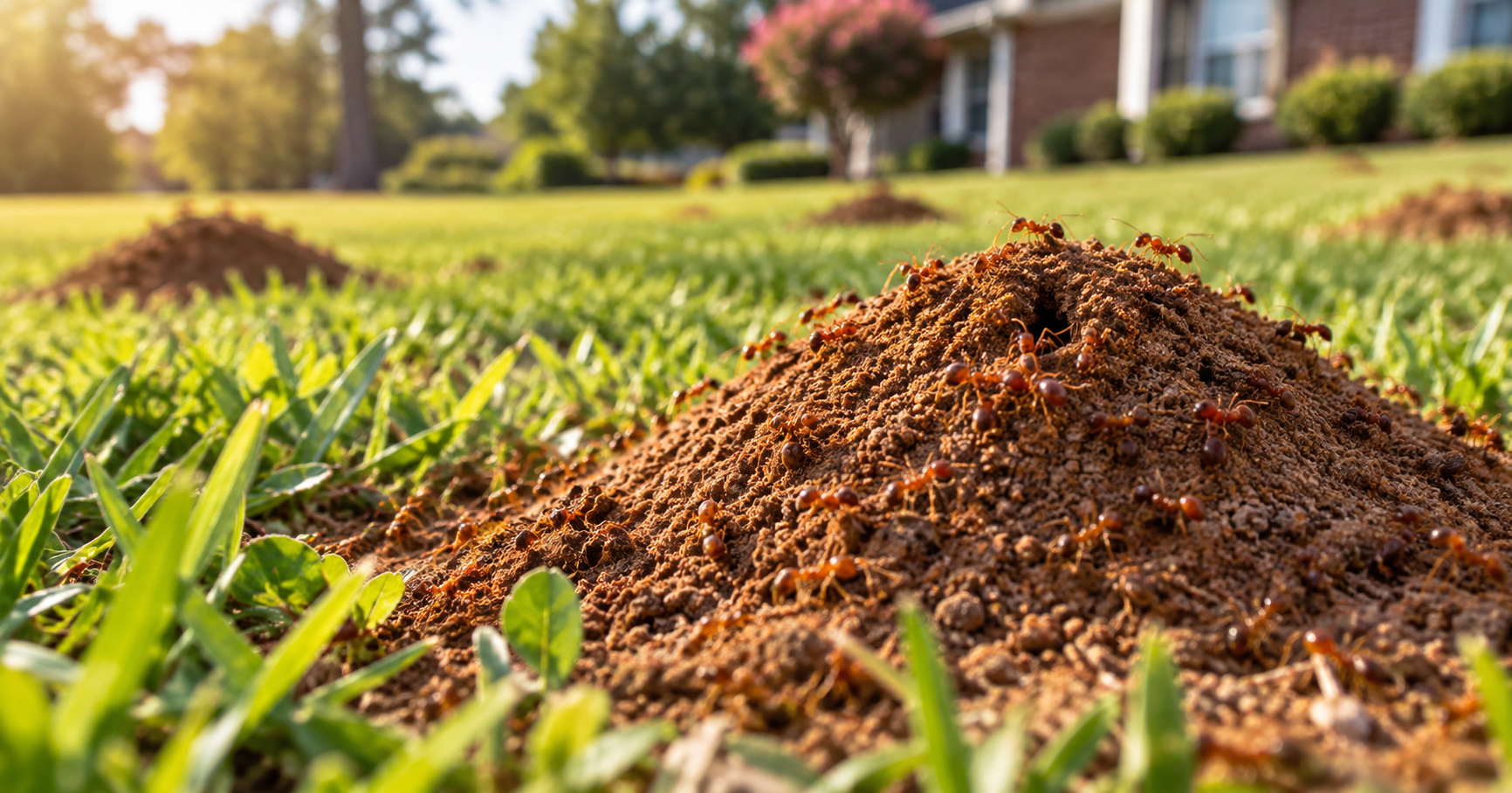
If raised dirt mounds seem to appear overnight across your lawn in Greenville, Winterville, Ayden, Farmville, Grifton, or elsewhere in Pitt County, North Carolina, fire ants may be the problem.
Fire ants are more than an inconvenience. When their nests are disturbed, workers can emerge quickly and sting repeatedly, making active colonies particularly concerning around children, pets, walkways, play areas, gardens, rental properties, and other heavily used portions of a yard.
The frustrating part for many Pitt County homeowners is that eliminating the mound you can see does not necessarily solve the entire problem. The visible mound represents only part of a colony living below ground, and new fire ant colonies can eventually move into treated properties from surrounding areas.
This guide answers common questions Pitt County property owners have about fire ant mounds, fire ant treatment, yard-wide control, prevention, and recurring infestations.
Already dealing with active fire ants? Learn about our professional fire ant treatment in Greenville and Pitt County, or visit our contact page to request service.
Are Fire Ants Common in Pitt County, North Carolina?
Fire ants are an established pest problem across much of North Carolina. The North Carolina Department of Agriculture & Consumer Services reports that portions or all of 81 of the state’s 100 counties are considered generally infested with one or more species of imported fire ant.
The NCDA&CS Imported Fire Ant Program also regulates the movement of certain materials that can transport imported fire ants, including soil-associated nursery stock and sod.
In residential landscapes, fire ants frequently establish colonies in sunny, open locations. Around Pitt County properties, homeowners may discover mounds in places such as:
- Front and back lawns
- Along sidewalks and driveways
- Around patios and outdoor living areas
- Near landscape edging
- Around HVAC pads and utility areas
- Flower and landscape beds
- Along fence lines
- Near drainage areas
- Around playground equipment
- In disturbed soil and recently landscaped areas
Small colonies are not always immediately noticeable. NC State Extension notes that mounds may become particularly noticeable following rainfall as ants move soil upward while responding to accumulating groundwater.
How Can I Tell If a Mound Is a Fire Ant Mound?
A mound of loose soil in the lawn does not automatically mean you have fire ants. Correct identification matters because different ant species require different management strategies.
According to NC State Extension’s fire ant guidance, red imported fire ants commonly create noticeable soil mounds in open areas such as lawns. A mature colony can contain an enormous population beneath the surface.
Possible signs of fire ant activity include:
- Loose or freshly worked soil forming a mound
- Multiple mounds appearing across sunny turf
- Large numbers of small reddish-brown ants responding aggressively when the colony is disturbed
- Recurring mounds near sidewalks, driveways, curbs, landscape edges, or other warm areas
- Painful stings after accidentally stepping on or working near a mound
Do not intentionally kick, step on, or dig into a suspected mound just to identify it. Disturbing an active fire ant colony can cause large numbers of workers to emerge rapidly.
For information about fire ants and other ant species found locally, see our guide to ants in Greenville and Pitt County.
Why Did Fire Ant Mounds Suddenly Appear After Rain?
This is one of the most common questions homeowners ask.
The ants may have already been present even though a prominent mound was not visible. After periods of rain, colonies can move soil upward, making existing nests much easier to notice.
That is why homeowners sometimes walk outside after a period of wet weather and feel as though fire ant colonies suddenly appeared throughout the lawn.
In reality, some of those colonies may have been developing before the visible mounds became obvious.
What Is Actually Under a Fire Ant Mound?
The mound you see above the grass is only the visible portion of a much larger underground nest.
NC State Extension reports that the underground portion of a fire ant nest may extend several feet into the soil. A mature colony can contain very large numbers of workers along with reproductive ants and one or more queens.
This explains one of the biggest mistakes in DIY fire ant control:
Killing ants on the surface is not the same as eliminating the colony.
An effective control strategy needs to affect the colony rather than simply killing the workers that happen to be visible at the time of treatment.
Why Do Fire Ant Mounds Keep Coming Back?
A mound returning after treatment does not necessarily mean that exactly the same thing happened each time. Several situations are possible.
The Queen Survived
If a treatment kills exposed workers but fails to affect the reproductive portion of the colony, surviving ants can continue maintaining the nest.
Satellite Mounds Developed Nearby
After some treatments or disturbances, surviving ants may appear in smaller nearby mounds. NC State recommends checking the surrounding area after mound treatments for new activity.
A New Colony Moved Into the Yard
Even successful treatment cannot place a permanent barrier around an entire property. Newly mated queens can establish colonies in suitable soil, meaning a previously treated lawn can eventually become reinfested.
Only Visible Mounds Were Treated
When numerous colonies are scattered across a property, chasing individual mounds may leave other colonies untouched.
This is one reason professional programs may use a broader yard-wide fire ant treatment strategy rather than relying exclusively on visible mound treatments.
Should You Treat the Mound or the Entire Yard?
The answer depends on the number of colonies, property layout, urgency, surrounding conditions, and treatment product being used.
There are two broad approaches to fire ant control.
Option 1: Individual Mound Treatment
Individual mound treatment targets a specific known colony.
NC State Extension notes that mound treatments can use less insecticide than treating a large area and may therefore reduce effects on non-target ground-dwelling insects. However, treating every mound individually can become time-consuming when a property contains numerous colonies.
Direct mound treatment may be particularly useful when an active colony is located in a high-risk location such as:
- Beside a doorway
- Near a child’s play area
- Along a frequently used walkway
- Near a patio
- Beside a mailbox
- Near areas regularly used by pets
Option 2: Broadcast or Yard-Wide Treatment
When fire ant pressure extends throughout the lawn, a broadcast treatment may be more practical than continually chasing individual mounds.
Broadcast applications treat a larger designated area according to the pesticide label. Depending on the product and strategy, this may involve bait or a contact/residual insecticide.
D & D Pest Control Co. offers a professional broadcast fire ant treatment program for Greenville and Pitt County lawns for properties where broader control is appropriate.
What Is the Two-Step Method for Fire Ant Control?
For some infestations, fire ant management can involve two complementary approaches: a broader bait treatment followed by treatment of persistent individual mounds.
NC State Extension describes a two-step approach combining baiting with direct mound treatment as an effective management strategy in appropriate situations.
The basic concept is straightforward:
- Address the broader population. A properly labeled fire ant bait can be distributed where actively foraging workers can collect it and carry it back toward the colony.
- Reinspect the property. Persistent active mounds can then be addressed using an appropriate mound treatment according to its label.
The exact procedure depends on the pesticide being used. Never assume two pesticides can be mixed, layered, or applied simultaneously unless their labels allow that use.
How Does Fire Ant Bait Work?
Fire ant bait is designed to take advantage of normal foraging behavior.
Worker ants find attractive bait particles and carry them back toward the colony, where the material can be shared within the nest. Because this process depends on foraging, bait treatment is generally slower than a direct contact treatment.
For bait to work properly, timing and conditions matter.
NC State recommends several important practices:
- Use fresh bait.
- Apply when fire ants are actively foraging.
- Avoid applying bait to wet grass.
- Avoid application when rain is expected soon after treatment when prohibited by the label.
- Do not unnecessarily disturb the mound before baiting.
- Follow the specific pesticide label regarding where and how the bait should be applied.
A bait treatment is not necessarily supposed to produce an instant pile of dead ants. Its purpose is to allow foraging ants to transport the active ingredient into the colony.
How Can You Tell If Fire Ants Are Actively Foraging?
NC State Extension describes a simple food-lure test that can help determine whether fire ants are actively looking for food.
A small oily food item, such as a potato chip, can be placed near the mound without disturbing it. If fire ants begin feeding on it within several minutes, that indicates active foraging.
This matters because bait depends upon workers finding and collecting it.
Always follow the pesticide’s label regarding application timing, weather, moisture, placement, and permitted treatment sites.
Are Fire Ant Mound Drenches Effective?
They can be when the product is labeled for that use and the treatment reaches enough of the colony.
A mound drench uses a relatively large volume of properly mixed insecticide solution to penetrate the nest. NC State Extension explains that adequate liquid volume is important because the treatment needs to reach ants below the surface rather than simply wetting the top of the mound.
Direct mound treatments can act faster than bait, which can make them useful where immediate reduction of an active mound is particularly important.
However, the pesticide label—not a generic online recipe—determines the correct concentration, application volume, treatment location, re-entry precautions, and other requirements for a particular product.
Should I Knock Down the Mound Before Treating It?
Usually, disturbing a mound immediately before treatment is not helpful unless a particular product label specifically directs you to do so.
Fire ants respond aggressively to disturbance. Physical disruption can also cause ants to move deeper into the soil or relocate within the colony.
NC State’s turf guidance recommends avoiding unnecessary disturbance before a direct treatment so ants remain in their normal nest positions.
If you are mowing a yard with active mounds, use caution around known colonies and keep people and pets away from the area.
What Is the Best Time of Year to Treat Fire Ants in Pitt County?
Fire ants can require attention whenever active colonies create a hazard, but environmental conditions affect treatment performance.
NC State Extension identifies late spring and early fall as particularly useful treatment periods and notes that chemical control is generally most effective while ants are active and temperatures are favorable.
Fall can be an especially important time to inspect a Pitt County lawn rather than assuming fire ant season is finished just because summer is ending.
For an active mound beside a walkway, play area, patio, doorway, or other high-use area, however, waiting months for an ideal seasonal window may not make sense. Treatment selection should account for the immediate risk as well as weather and label requirements.
Does Hot Summer Weather Affect Fire Ant Treatment?
Yes.
During very hot weather, fire ants may remain deeper underground during the hottest part of the day. This can make some direct mound treatments less effective if they fail to reach enough of the colony.
NC State notes that spring and fall often provide better conditions and that morning or evening treatment may be preferable during hot summer weather, depending on the treatment method and product label.
This is another reason that timing matters almost as much as the product itself.
Can Rain Make Fire Ant Problems Worse?
Rain does not necessarily create a new colony overnight, but it can make existing colonies more visible.
After heavy rainfall, homeowners often notice fresh soil and new-looking mounds across their yards. In addition, rainfall and soil moisture can affect when certain pesticide products should be applied.
For example, bait generally needs suitable dry conditions so foraging ants can collect it before moisture damages the food carrier. Other granular products may require watering after application.
Never assume that all granular fire ant products are applied the same way. Some need irrigation; some bait products need to remain dry. Read and follow the label for the exact product being used.
Can Fire Ants Be Permanently Eliminated From a Yard?
It is more realistic to think in terms of control, suppression, monitoring, and prevention of unacceptable colony levels rather than promising that a yard can never have another fire ant.
Even after successful treatment, newly mated queens can establish colonies in suitable areas. Fire ants can also be transported through movement of infested materials.
NC State Extension specifically notes that reinvasion can occur, which is why periodic monitoring is an important part of an effective management program.
For homeowners with recurring pressure, prevention therefore becomes an ongoing process rather than a single mound treatment.
Can New Sod, Plants, or Landscaping Bring Fire Ants Onto a Property?
Potentially, yes.
Fire ants can be transported in soil and landscaping materials. NC State recommends checking materials such as sod, shrubs, pine straw, and other landscape materials for fire ant activity.
The North Carolina Department of Agriculture also maintains imported fire ant quarantine requirements because certain soil-associated materials can contribute to human-assisted spread.
If you’re installing landscaping at a Pitt County home:
- Inspect sod and soil before installation.
- Watch newly landscaped areas for mound development.
- Check around root balls and container-grown plants.
- Use reputable landscape and nursery suppliers.
- Monitor disturbed soil after grading or construction.
Do Home Remedies Kill Fire Ant Colonies?
Be skeptical of internet remedies.
NC State Extension specifically reports that commonly suggested remedies such as instant grits, molasses, aspartame, and club soda do not provide effective fire ant control.
More importantly, never pour gasoline, diesel fuel, chlorine, ammonia, or similar chemicals onto a fire ant mound. These substances can create unnecessary hazards and contaminate soil or groundwater.
Boiling or very hot water can kill many ants, but research cited by NC State indicates surviving ants may establish satellite mounds nearby. Hot water can also damage turf and landscape plants and creates an obvious burn hazard for the person carrying and pouring it.
A pesticide specifically labeled for fire ant control—or a professional treatment program—is generally a much more predictable approach.
Are Fire Ants Dangerous to Children and Pets?
Fire ants aggressively defend their nests. A person or animal that unknowingly steps on or lies near an active mound may receive multiple stings before getting away.
That makes mound location especially important.
Pay particular attention to colonies around:
- Children’s playsets
- Sandboxes
- Dog runs
- Pet feeding areas
- Patios
- Pool areas
- Walkways
- Mailboxes
- Garden work areas
- Outdoor seating
Anyone who develops signs of a serious allergic reaction after an insect sting should seek appropriate emergency medical attention.
When Can Children and Pets Return to a Treated Yard?
There is no single re-entry time that applies to every fire ant pesticide.
The product label controls.
Some treatments require people and pets to remain out of the treatment area until an application has dried. Other products have different directions or precautions.
A professional pest control company should explain the relevant post-treatment instructions for the specific product and application method used at your property.
Can I Use Fire Ant Products Around a Vegetable Garden?
Do not assume a lawn pesticide is legal or appropriate for use around edible plants.
Some fire ant products are labeled for particular garden situations; others are not. The pesticide label identifies where the product can legally be used.
Before applying anything near:
- Vegetable gardens
- Fruit trees
- Herb gardens
- Chicken areas
- Livestock areas
- Ponds or drainage ditches
check the complete label carefully.
NC State’s Red Imported Fire Ant in North Carolina guide provides additional information about treatment options and precautions.
What About Fire Ant Treatment Near Ponds, Ditches, or Streams?
Extra caution is necessary around water.
Some insecticide active ingredients used for outdoor ant control can be highly toxic to fish and aquatic invertebrates. Product labels may contain specific restrictions designed to prevent drift, runoff, or direct application into water.
Pitt County properties with ponds, drainage ditches, streams, wetlands, or areas that drain directly into surface water should be evaluated carefully before treatment.
Never assume that a product suitable for the middle of a lawn is appropriate along the edge of a pond or drainage channel.
Can Fire Ants Enter a House?
Yes, although they primarily nest outdoors.
Fire ants can forage around buildings and occasionally enter structures searching for food and other resources. In some situations, colonies may occur beneath slabs or near structural openings.
Reducing outdoor colonies is an important part of preventing indoor fire ant activity.
Homeowners can also reduce attractive conditions by:
- Keeping outdoor trash areas clean
- Removing spilled pet food
- Cleaning outdoor cooking areas
- Trimming vegetation away from structures
- Sealing accessible openings where practical
- Addressing persistent ant colonies around the foundation
If ants are already entering the structure, visit our Ant Control in Greenville, NC page for information about professional identification and colony-focused treatment.
How Can Pitt County Homeowners Help Prevent Fire Ant Problems?
No landscaping practice can guarantee that a newly mated queen will never establish a colony, but homeowners can make fire ant management easier through regular inspection and early action.
Inspect the Yard Regularly
Walk the property periodically during warm weather and after significant rainfall. Finding colonies while they are small can make management easier.
Pay Attention to High-Risk Areas
Look around sunny turf, sidewalks, driveways, utility areas, landscape borders, playgrounds, fence lines, and disturbed soil.
Inspect New Landscape Materials
Check sod, soil, plants, mulch, pine straw, and other landscape materials for suspicious ant activity before spreading them around the property.
Reduce Outdoor Food Sources
Clean up pet food, spilled garbage, grease, and outdoor cooking residue that may encourage ant foraging around the home.
Do Not Rely on Mound Chasing Alone
If new mounds continually appear throughout the lawn, it may be time to consider a broader strategy instead of treating one mound at a time.
Reinspect After Treatment
Fire ant management should include follow-up. Check treated areas for surviving activity, satellite mounds, or newly established colonies.
When Should You Call a Pest Control Professional?
A single isolated mound in a low-use part of a large property may be manageable with a properly labeled homeowner product. Professional treatment becomes more attractive when the infestation is widespread, repeatedly returns, or creates a significant sting hazard.
Consider professional fire ant control when:
- Numerous mounds are scattered throughout the yard.
- New mounds keep appearing after DIY treatment.
- Fire ants are near children’s play areas.
- Pets frequently use the infested area.
- Mounds occur around sidewalks, patios, or entrances.
- You manage a rental property or multi-family property.
- The lawn has recurring fire ant pressure every year.
- You want a yard-wide treatment rather than individual mound chasing.
- You are unsure which pesticide is appropriate for the site.
D & D Pest Control Co. provides fire ant treatment for Greenville and Pitt County properties as well as broader pest control services in Greenville, NC.
Fire Ant Treatment for Greenville and Pitt County Yards
Fire ant management is not simply about knocking down the largest mound in the lawn. The goal is to address active colonies while reducing the likelihood that untreated colonies continue spreading across the property.
A professional fire ant program may involve:
- Inspection of active mound locations
- Evaluation of the overall level of fire ant pressure
- Identification of high-risk areas
- Selection of an appropriate treatment strategy
- Targeted mound treatment where appropriate
- Broadcast treatment where appropriate
- Post-treatment instructions
- Monitoring for recurring activity
For properties experiencing widespread activity, learn more about our Topchoice® Fire Ant Treatment in Greenville, NC and Pitt County.
Frequently Asked Questions About Fire Ants in Pitt County
Why are there suddenly fire ant mounds all over my yard?
Existing colonies may become much more noticeable following rainfall, and growing colonies can produce increasingly visible mounds. Newly established colonies can also develop as reproductive queens move into suitable areas.
Does killing the mound kill the entire fire ant colony?
Not necessarily. Successful treatment needs to affect the colony, including the reproductive ants. Killing only exposed workers may provide temporary visible results without eliminating the underlying colony.
Should I put fire ant bait directly on top of the mound?
Not automatically. Many fire ant baits are intended to be placed where workers actively forage rather than simply dumped onto the mound. Follow the exact product label.
Should I disturb a fire ant mound before treatment?
Generally, unnecessary disturbance is discouraged because it causes defensive activity and can move ants deeper into the nest. Follow the treatment product’s directions.
What is better: fire ant bait or mound treatment?
They serve different purposes. Baits are generally slower and depend on worker ants carrying the material into the colony. Direct mound treatments can provide faster control of specific colonies. Properties with widespread activity may benefit from a broader treatment strategy.
Why did another mound appear beside the one I treated?
Surviving ants can sometimes establish satellite mounds nearby, or the new mound may represent a separate colony that was already present.
Will treating my yard prevent fire ants forever?
No treatment can guarantee that a property will never be reinfested. New queens can establish colonies, which is why monitoring and periodic management are important.
What is the best season for fire ant treatment in Pitt County?
Late spring and early fall commonly provide favorable treatment conditions in North Carolina, although dangerous active mounds may need attention whenever conditions and product labeling permit treatment.
Can fire ants be transported in sod or landscaping?
Yes. Fire ants can be moved in soil-associated materials, including sod and nursery materials. Inspect new landscaping materials and monitor recently landscaped areas.
Do grits kill fire ants?
No. NC State Extension identifies grits and several other popular home remedies as ineffective fire ant controls.
Don’t Just Chase the Next Fire Ant Mound
If you’re finding one mound after another in a Pitt County lawn, the bigger question isn’t simply “What can I pour on this mound?”
It’s:
“Do I have one isolated colony, or does my property need a broader fire ant management plan?”
That distinction can determine whether you’re eliminating a specific problem or spending the entire warm season chasing new mounds around the yard.
D & D Pest Control Co. provides professional pest control for homeowners, landlords, property managers, and businesses in Greenville, Winterville, Ayden, Farmville, Grifton, Simpson, and surrounding Pitt County communities.
Need help with fire ants?
Learn About Our Fire Ant Treatment Program
Request Pest Control Service
Office: (252) 523-8255
Manager: (252) 531-0621
Fire Ant Resources for North Carolina Homeowners
For additional research and pesticide guidance, homeowners can consult these authoritative North Carolina resources:
- NC State Extension — Red Imported Fire Ant in North Carolina
- NC State Extension — Red Imported Fire Ants in the Landscape
- NC State Extension — Fire Ants in Commercial Turfgrass, Home Lawns and Landscapes
- North Carolina Department of Agriculture & Consumer Services — Imported Fire Ant Program
Pesticide reminder: Always read and follow the complete product label. The label determines where a pesticide may be used, application rates, environmental precautions, personal-protection requirements, re-entry instructions, and other legally required directions.
#ant control #Fire Ant Control #Fire Ant Mounds #Fire Ant Prevention #Fire Ant Treatment #Fire Ants #Greenville NC Fire Ants #Greenville NC pest control #Lawn Pest Control #North Carolina Fire Ants #Pitt County pest control #Yard Pest Control
Related Posts
 German Cockroach Gel Baiting: How It Works and Why It’s Effective
 VA & FHA Wood Destroying Insect Reports in Greenville, NC | Pitt County Termite Inspections
 Bed Bugs on the Rise? What Greenville, NC Homeowners Need to Know in 2026