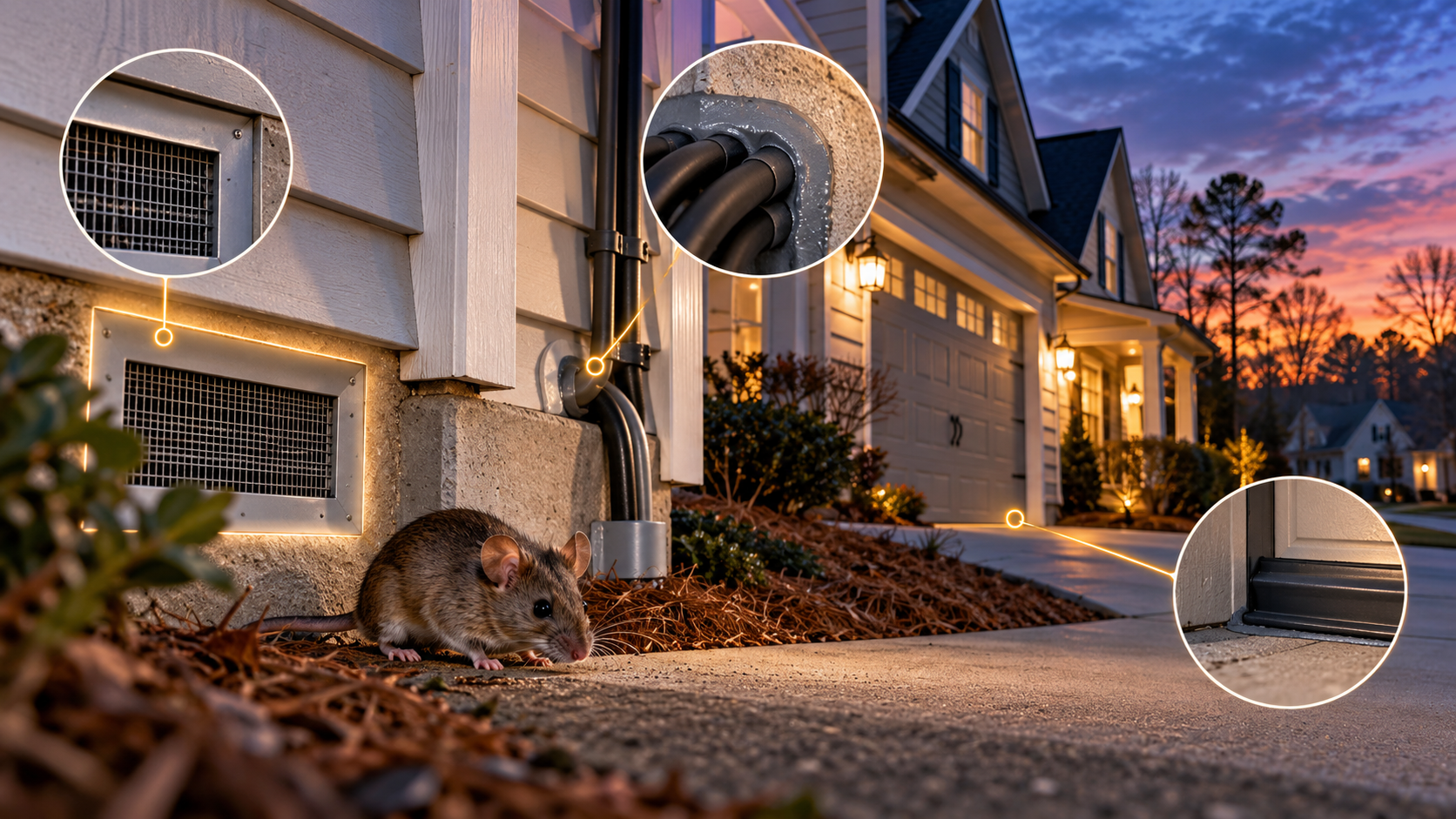
When temperatures begin dropping across Greenville, Pitt County, and Eastern North Carolina, homes and businesses can become attractive shelter for mice and rats. Rodents do not need an open door to get inside. Small gaps around plumbing lines, crawlspace vents, foundations, garage doors, siding, rooflines, utility penetrations, and other construction openings can provide an entry route into a structure.
D & D Pest Control Co. provides professional winter mouse and rodent proofing in Greenville, NC and surrounding Eastern North Carolina communities. Our approach focuses on identifying rodent activity, locating possible entry points, reducing conditions that attract rodents, and developing a practical control and exclusion plan for the property.
If you are already hearing scratching inside walls, finding droppings beneath a sink, discovering damaged food packages, or noticing activity in the attic or crawlspace, visit our Rodent Control in Greenville, NC page or contact D & D Pest Control Co. to schedule an inspection.
Why Mice and Rats Become a Bigger Concern During Colder Weather
Rodents need the same basic resources throughout the year: food, water, shelter, and suitable nesting areas. Buildings can provide all four.
During cooler weather, areas such as crawlspaces, garages, attics, utility rooms, storage areas, kitchens, warehouses, sheds, restaurants, rental properties, and other protected spaces may offer rodents shelter from outdoor conditions.
A small exterior opening can eventually become an interior rodent problem. According to the Centers for Disease Control and Prevention’s rodent exclusion guidance, mice can fit through an opening approximately 1/4 inch wide—roughly the width of a pencil.
That is why winter rodent prevention should involve much more than simply putting a trap in the kitchen after a mouse has already appeared.
Professional Rodent Proofing in Greenville, NC
Rodent proofing—often called rodent exclusion—focuses on finding and correcting accessible openings rodents may use to enter a building.
A winter rodent evaluation may include inspection of:
- Foundation openings and cracks
- Crawlspace entrances and vents
- Plumbing penetrations
- Electrical and cable penetrations
- HVAC lines
- Exterior doors and thresholds
- Garage-door edges
- Damaged weatherstripping
- Soffits, fascia and roofline openings
- Attic vents
- Siding transitions
- Areas beneath sinks
- Water-heater and utility penetrations
- Gaps behind appliances
- Storage rooms and garages
- Exterior conditions providing rodent harborage
The objective is straightforward: find how rodents may be entering, address accessible entry points where appropriate, control rodents already inside, and reduce conditions that can encourage another infestation.
How Mice Get Into Greenville-Area Homes
One of the biggest mistakes homeowners make is looking only for large holes. Mouse entry points can be surprisingly small.
Common problem areas include gaps where:
- Air-conditioning lines enter the structure
- Water pipes pass through floors or walls
- Electrical wiring enters the building
- Cable and internet lines penetrate siding
- Garage doors do not seal completely
- Crawlspace doors have deteriorated
- Vents or screens are damaged
- Siding meets the foundation
- Rooflines meet soffits and fascia
- Exterior doors lack effective weatherstripping
The CDC recommends examining both the interior and exterior of a structure and specifically checking around doors, windows, foundations, pipes, utility lines, attics, crawlspaces, vents, eaves, gables and soffits.
Signs You May Already Have Mice or Rats
You do not necessarily have to see a live mouse to have a rodent problem. Rodents frequently remain concealed behind walls, beneath cabinets, above ceilings, inside crawlspaces or in storage areas.
Watch for these rodent warning signs:
- Small dark droppings
- Scratching or movement inside walls
- Noises in the attic or ceiling at night
- Gnaw marks on food containers
- Chewed cardboard or paper
- Damaged insulation
- Nesting material
- Greasy rub marks along travel routes
- Pet food being disturbed
- Unusual odors in enclosed areas
- Evidence of gnawing around structural openings
- A live or dead mouse or rat
The CDC recommends checking regularly for rodent droppings and gnaw marks because these may appear before a homeowner sees the rodent itself.
Winter Mouse Control Starts Outside the House
Controlling rodents inside the home is only part of the solution. Long-term prevention begins by looking at the property from the outside.
Foundation and Crawlspace Inspection
Eastern North Carolina homes frequently have crawlspaces, utility penetrations, foundation vents, access doors, plumbing penetrations and other areas that deserve careful inspection.
A damaged crawlspace door or opening around a utility pipe can give rodents access beneath the home. Once inside the crawlspace, additional openings around plumbing, ductwork or wiring may provide pathways into living areas.
Doors and Garage Openings
Check exterior doors for visible daylight along the bottom and sides. Garage doors deserve particular attention because worn seals and uneven surfaces can leave openings along the corners.
Roofline, Soffits and Attic Openings
Rodent inspection should not stop at ground level. Openings around soffits, fascia, vents, roof transitions and other elevated areas should also be evaluated.
Utility Penetrations
Plumbing, HVAC, electrical, cable and communications lines often require holes through exterior walls. These penetrations should be appropriately sealed while allowing the system itself to function safely.
What Does Rodent Exclusion Involve?
Not every hole should be filled with the same material. Effective exclusion depends on the location, size, building material and purpose of the opening.
Depending on the situation, rodent-proofing materials may include appropriately installed:
- Metal screening
- Hardware cloth
- Metal flashing
- Door sweeps
- Weatherstripping
- Sealants
- Other durable construction materials suitable for the opening
The CDC notes that larger openings may require materials such as metal, cement, hardware cloth, lath screen or metal sheeting rather than relying only on easily damaged material.
Exclusion also has to be performed carefully. If rodents are already inside a structure, simply closing every visible opening without considering the existing population can create additional problems. Inspection and a coordinated control plan are important.
Rodent Trapping and Control
If mice or rats have already entered the building, exclusion may need to be combined with trapping, monitoring or other professional control methods.
D & D Pest Control Co.’s dedicated Greenville rodent control service addresses mouse and rat problems through inspection, exclusion recommendations, strategic trapping or baiting where appropriate, sanitation recommendations, and follow-up monitoring.
The exact approach depends on the rodent involved, where activity is occurring, the type of structure, environmental conditions, access points and the severity of the infestation.
Do Not Ignore Food and Water Sources
Even excellent structural exclusion works better when food, water and nesting opportunities are reduced.
Inside the Home
- Store pantry food in secure containers.
- Clean crumbs and food spills promptly.
- Do not routinely leave pet food out overnight.
- Keep garbage containers covered.
- Inspect beneath kitchen appliances periodically.
- Repair plumbing leaks.
- Clean food residue beneath cabinets and shelving.
- Reduce unnecessary cardboard and clutter.
Outside the Home
- Keep garbage cans securely closed.
- Avoid allowing pet food to remain outdoors overnight.
- Clean grills and outdoor cooking areas.
- Reduce weeds and heavy vegetation against the structure.
- Keep stored materials organized.
- Inspect sheds and detached garages.
- Reduce unnecessary debris and hiding areas around the foundation.
These principles follow the CDC’s recommended approach of removing food, water and shelter while sealing potential rodent entry points.
Why Rodents Should Not Be Ignored
A mouse problem is more than an annoyance. Rodents can contaminate stored food and surfaces with urine, droppings and nesting material. They may also gnaw on insulation, cardboard, stored materials and other components inside a building.
The CDC notes that rodents can carry diseases that may spread through direct contact with rodents or contact with urine, droppings or saliva. Rodents can also carry parasites such as fleas, ticks and mites.
Because of those concerns, homeowners should also use proper precautions when cleaning areas contaminated by rodents.
Important: Do Not Sweep or Vacuum Dry Rodent Droppings
If you find rodent droppings, urine or nesting material, avoid immediately sweeping or vacuuming the material while it is dry.
The CDC provides specific recommendations for safely cleaning rodent-contaminated areas. Review the agency’s current rodent-control and cleanup guidance before attempting significant cleanup.
For extensive contamination, inaccessible nesting areas or continuing rodent activity, professional evaluation may be appropriate.
Winter Rodent Proofing for Crawlspace Homes
Crawlspace homes deserve special attention during a rodent inspection because the crawlspace connects numerous building systems beneath the living area.
Potential concerns may include:
- Damaged crawlspace access doors
- Missing or damaged vent screens
- Plumbing penetrations through the subfloor
- HVAC penetrations
- Electrical penetrations
- Gaps near foundation transitions
- Damaged insulation
- Stored materials beneath the home
- Moisture or plumbing leaks
A rodent underneath the structure may eventually locate another opening that leads into kitchens, bathrooms, utility spaces or wall cavities. That is why inspecting both the exterior perimeter and crawlspace can be important.
Mouse Proofing for Rental Properties in Greenville
Rental houses, duplexes, apartments and other managed properties can develop recurring mouse problems when structural openings and sanitation conditions are not addressed together.
Property managers should pay particular attention during tenant turnover. An empty unit provides an opportunity to inspect:
- Behind refrigerators and ranges
- Beneath kitchen and bathroom sinks
- Utility penetrations
- Water-heater closets
- Exterior doors
- Attached storage areas
- HVAC penetrations
- Kitchen cabinetry
- Crawlspace entrances
Owners and property managers can also review our Greenville pest control services for ongoing property protection options.
Winter Rodent Prevention for Greenville Restaurants and Businesses
Commercial rodent prevention requires special attention because frequent deliveries, loading areas, dumpsters, food storage, utility penetrations and regularly opened exterior doors can create additional pest pressure.
Restaurants should monitor:
- Receiving doors
- Door sweeps
- Dry-food storage rooms
- Areas beneath cooking equipment
- Plumbing penetrations
- Dumpster areas
- Floor drains and utility areas
- Cardboard storage
- Exterior vegetation
- Building penetrations
For additional guidance, read our Restaurant Pest Control in Greenville, NC: How to Prevent Roaches, Flies, and Rodents.
When Is the Best Time to Rodent-Proof a Home?
Before you begin seeing mice indoors.
Preventive inspection during late summer and fall gives homeowners an opportunity to locate potential openings before colder-weather rodent pressure develops. However, rodent exclusion can be useful at any time of year when mice or rats are entering a structure.
If you are already seeing activity, waiting can allow rodents additional time to establish nesting areas or discover reliable food sources.
DIY Mouse Proofing vs. Professional Rodent Inspection
Homeowners can correct many obvious conditions themselves, including replacing damaged weatherstripping, keeping food secured, closing garbage containers and reducing clutter.
The difficulty is locating the less obvious openings.
A mouse may enter at one point on the exterior, travel beneath the building or through a wall cavity, and appear somewhere completely different inside the home. Concentrating only on the room where a mouse was seen may miss the actual source.
Professional rodent inspection is particularly useful when:
- Mice keep returning after trapping.
- You cannot locate the entry point.
- Activity is occurring inside walls or ceilings.
- The property has a large crawlspace or attic.
- You are finding repeated droppings.
- There is commercial or rental-property activity.
- Multiple parts of the building show evidence.
- Previous DIY efforts have not solved the problem.
Our Winter Rodent Control Process
1. Property Inspection
We evaluate areas associated with observed or suspected rodent activity and look for accessible entry points and conditions contributing to the problem.
2. Identify Rodent Activity
Droppings, gnawing, nesting material, rub marks, travel routes, food damage and other evidence help determine where activity is concentrated.
3. Locate Potential Entry Points
Exterior openings, foundations, doors, crawlspaces, utility penetrations and other accessible building areas are evaluated where appropriate.
4. Develop a Control Plan
Depending on the findings, recommendations may include trapping, monitoring, baiting where appropriate, sanitation improvements, exclusion work or structural repairs.
5. Prevention and Follow-Up
Rodent management is most effective when the source of the problem is addressed instead of simply removing an individual mouse.
Why Choose D & D Pest Control Co.?
D & D Pest Control Co. has served Eastern North Carolina since 1994. We provide pest and termite services for homeowners, businesses, landlords, property managers and real estate professionals throughout Greenville, Pitt County and surrounding communities.
Our local pest-control services include:
- Mouse and rat control
- Rodent exclusion and prevention
- General pest control
- Cockroach control
- Ant control
- Spider control
- Flea control
- Termite inspections and treatments
- Commercial pest control
- Rental-property pest management
- Wood Destroying Insect Reports
Learn more about our company and experience on our About D & D Pest Control Co. page.
Winter Mouse & Rodent Proofing Service Areas
D & D Pest Control Co. provides pest and rodent-control services throughout Greenville, Pitt County and other communities across our Eastern North Carolina service area, including:
- Greenville, NC
- Winterville, NC
- Ayden, NC
- Grifton, NC
- Farmville, NC
- Simpson, NC
- Snow Hill, NC
- Kinston, NC
- La Grange, NC
- Pink Hill, NC
- Trenton, NC
- Vanceboro, NC
- New Bern, NC
- Jacksonville, NC
- Richlands, NC
- And surrounding Eastern North Carolina communities
If you are outside Greenville or Pitt County, contact our office to confirm service availability for your property.
Frequently Asked Questions About Winter Rodent Proofing in Greenville, NC
Why am I seeing mice in my Greenville home during colder weather?
Homes provide shelter along with potential food, water and nesting locations. If a structure has accessible gaps around doors, foundations, utility lines, crawlspaces, vents or roof areas, rodents may use those openings to enter.
How small of a hole can a mouse enter?
The CDC reports that a mouse can fit through a hole approximately 1/4 inch or 6 millimeters wide. This is why seemingly insignificant openings should not automatically be dismissed during an exclusion inspection.
Where should I look for mouse entry points?
Start around exterior doors, garage doors, foundations, crawlspace entrances, utility lines, plumbing penetrations, dryer vents, attic vents, siding, soffits and roof transitions. Interior areas beneath sinks, behind appliances and around utility penetrations should also be inspected.
Does seeing one mouse mean I have an infestation?
Not necessarily, but seeing a mouse means the animal gained access to the building. The appropriate next step is to inspect for droppings, gnaw marks, nesting material and potential entry points rather than assuming the mouse was an isolated event.
Will sealing holes permanently stop mice?
Exclusion is an important part of long-term rodent prevention, but an active infestation may also require trapping or another control strategy. Food sources, sanitation, exterior harborage and additional undiscovered entry points should also be addressed.
Should I seal mouse holes immediately if mice are already inside?
Active rodent problems should be evaluated carefully before indiscriminately closing openings. A coordinated strategy should account for rodents already inside the structure while preventing additional entry.
Can mice get into a home through the crawlspace?
Yes. Crawlspace access doors, damaged vents, utility penetrations and foundation openings can provide access beneath a home. Rodents may then locate openings around plumbing, electrical lines, ducts or other penetrations leading upward.
Can mice enter through the garage?
Yes. Gaps beneath or around garage doors and damaged weather seals can provide rodent entry points. Attached garages are especially important because additional doors and wall penetrations may connect the garage with the home.
Should I use spray foam to stop mice?
The appropriate repair depends on the opening and construction material. Rodent-prone openings often benefit from durable materials that resist gnawing. Larger holes may require metal screening, hardware cloth, flashing, cement or another suitable construction material rather than relying solely on foam.
Will keeping my house clean prevent mice?
Sanitation helps reduce food and nesting opportunities, but even a clean house can develop a mouse problem if rodents have an accessible entry point. The strongest prevention strategy combines sanitation with structural exclusion.
Does pet food attract mice?
Pet food can provide an accessible food source for rodents. Store pet food in secure containers, clean spills and avoid leaving unnecessary food out overnight.
Do bird feeders attract rodents?
Spilled birdseed can provide an outdoor food source for rodents. If rodent activity develops around a home, evaluate bird-feeding areas and other outdoor food sources as part of the prevention plan.
Can rodents damage my home?
Rodents can gnaw cardboard, food packaging, insulation and other materials. Persistent rodent activity inside structural areas should therefore be investigated rather than ignored.
Is it safe to vacuum mouse droppings?
The CDC advises against sweeping or vacuuming dry rodent urine, droppings or nesting material. Follow current CDC guidance for wetting, disinfecting and safely removing rodent-contaminated material.
Do you provide mouse extermination in Greenville, NC?
Yes. D & D Pest Control Co. provides professional mouse and rodent control for Greenville and surrounding Pitt County communities. Service may include inspection, trapping or baiting where appropriate, exclusion recommendations and ongoing monitoring depending on the situation.
Do you provide rodent control for rental properties?
Yes. We work with homeowners, landlords and property managers. Rental properties can particularly benefit from rodent inspection during vacancies and tenant turnover because kitchens, utility areas and other normally obstructed locations may be easier to evaluate.
Do you provide rodent control for Greenville businesses and restaurants?
Yes. Commercial rodent programs can be developed for restaurants, offices, retail properties, warehouses and other businesses based on the building, sanitation conditions, pest pressure and monitoring requirements.
When should I call a professional mouse exterminator?
Consider professional service when mice continue returning, you find repeated droppings, hear activity inside walls or ceilings, cannot locate the entry point, or DIY trapping does not resolve the problem.
Schedule Winter Mouse & Rodent Proofing in Greenville, NC
Do not wait until scratching inside the walls becomes the first sign that rodents have moved indoors.
If you own a home, rental property, restaurant or business in Greenville, Winterville, Ayden, Grifton, Farmville, Pitt County or surrounding Eastern North Carolina communities, D & D Pest Control Co. can evaluate your rodent problem and help develop an appropriate control and prevention strategy.
D & D Pest Control Co.
Serving Greenville, Pitt County & Eastern North Carolina Since 1994
Office: (252) 523-8255
Manager: (252) 531-0621
Keep the mice outside this winter. Inspect early, eliminate entry points, and address rodent activity before a small problem becomes a recurring one.
#Ayden NC Pest Control #Commercial Rodent Control #Crawlspace Rodent Control #D & D Pest Control Co. #Eastern North Carolina pest control #Farmville NC Pest Control #Greenville NC exterminator #Grifton NC Pest Control #Home Rodent Proofing #Mice in House Greenville NC #Mouse Control Greenville NC #Mouse Exterminator Greenville NC #Mouse Prevention #Pest Control Greenville NC #Pitt County pest control #Rat Control Greenville NC #Rental Property Rodent Control #rodent control Greenville NC #Rodent Entry Point Sealing #Rodent Exclusion Greenville NC #rodent prevention #Rodent Proofing Greenville NC #Winter Mouse Proofing #Winter Rodent Control #Winterville NC Pest Control
Related Posts
 German Cockroach Gel Baiting: How It Works and Why It’s Effective
 VA & FHA Wood Destroying Insect Reports in Greenville, NC | Pitt County Termite Inspections
 Bed Bugs on the Rise? What Greenville, NC Homeowners Need to Know in 2026