
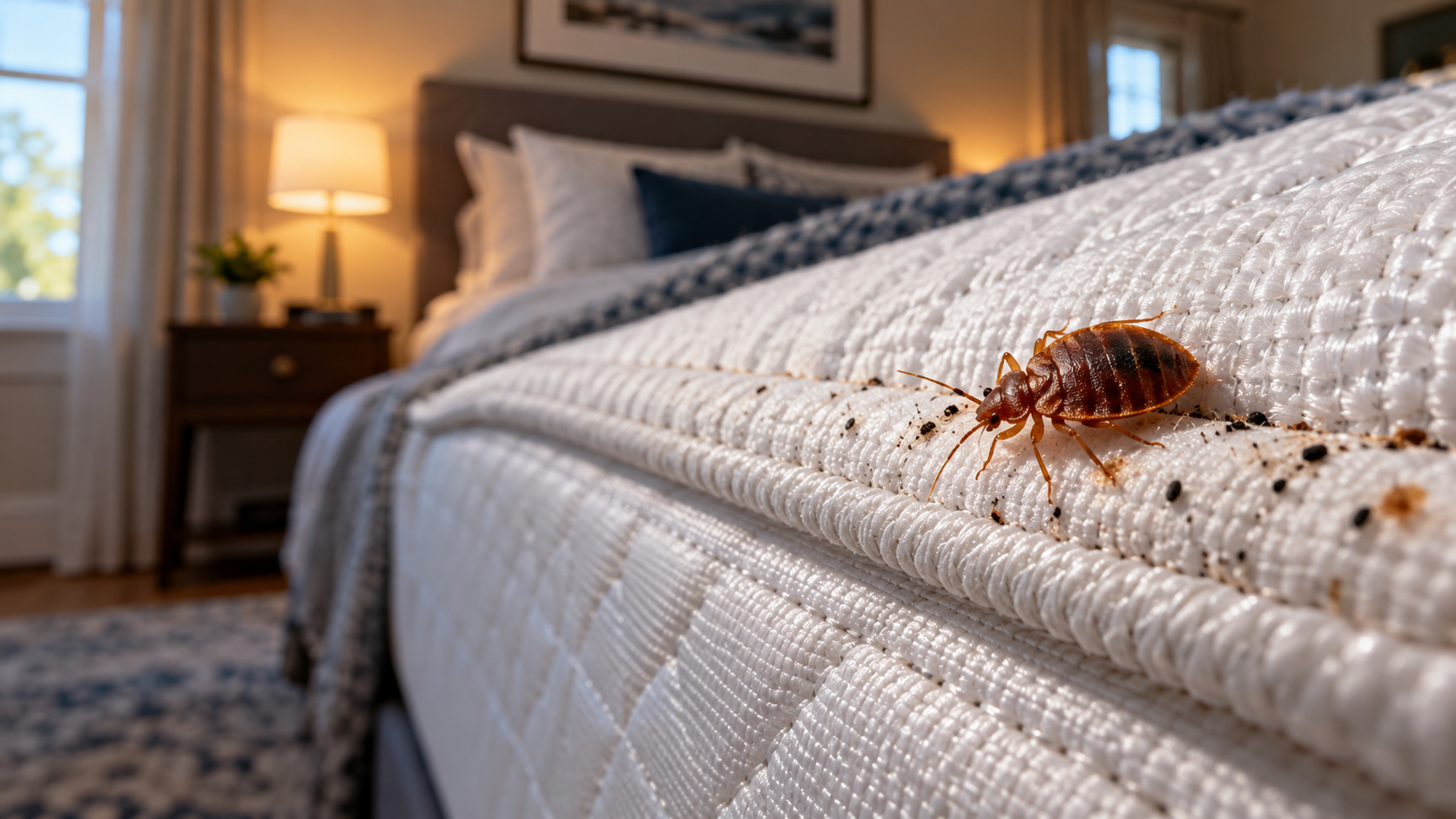
Finding a suspicious bug on your mattress, waking up with unexplained bites, or noticing tiny dark spots around your bed can quickly turn an ordinary evening into a stressful one. For homeowners, renters, landlords, and property managers in Greenville, North Carolina, bed bugs remain a pest worth knowing how to identify—and knowing what to do about before a small problem becomes harder to manage.
But are bed bugs actually “on the rise” in Greenville in 2026? There is no reliable public Greenville or Pitt County surveillance database that allows us to say that local bed bug infestations have increased by a specific percentage. What we can say is that bed bugs remain established throughout the United States, they are excellent hitchhikers, and the movement of people, luggage, furniture, and belongings continually creates opportunities for new infestations.
Greenville has many of the environments where introductions can occur: single-family homes, apartments, rental properties, hotels, student housing, short-term lodging, and a highly mobile population associated with East Carolina University, healthcare, business, tourism, and everyday travel.
If you live in Greenville or elsewhere in Pitt County, understanding what bed bugs look like, how they spread, where they hide, and which warning signs deserve attention can help you respond before the situation becomes more complicated.
D & D Pest Control Co. has provided professional pest control services in Eastern North Carolina since 1994. If you already suspect an infestation, you can learn more about our bed bug services in Greenville, NC.
Are Bed Bugs Really Increasing in Greenville, NC?
It is tempting to describe every increase in calls, sightings, online discussions, or individual experiences as a local “bed bug outbreak.” From an evidence standpoint, however, homeowners should be cautious with claims that cannot be supported by actual surveillance data.
What is well established is that bed bugs continue to be a persistent pest throughout the United States. According to the Centers for Disease Control and Prevention, bed bugs can be found in homes, apartments, shelters, hotels, dormitories, buses, trains, and other locations where people live, sleep, or travel.
The presence of bed bugs is also not an indication that a home is dirty. Bed bugs need access to a host—not an unsanitary kitchen or an unclean house. A clean, well-maintained Greenville home can acquire bed bugs just as an apartment, hotel room, rental house, or student residence can.
Instead of focusing only on whether bed bug numbers are technically “rising,” a more useful question for Greenville homeowners is:
Are there realistic opportunities for bed bugs to be introduced into my home?
For many households, the answer is yes.
Why Greenville Homes Can Be Vulnerable to Bed Bug Introductions
Bed bugs do not normally invade a house from the lawn like ants or crawl into an attic the way certain other pests might. They are primarily transported from one location to another on belongings.
That makes human movement one of the most important factors in bed bug spread.
1. Travel and Overnight Stays
Bed bugs can hide in seams, folds, pockets, and protected areas of luggage, backpacks, clothing, bedding, and other personal belongings. A person can unknowingly bring one or more bed bugs home following a hotel stay, vacation, business trip, hospital stay, overnight visit, or other travel.
The CDC notes that bed bugs commonly spread by hiding in luggage, overnight bags, folded clothing, bedding, furniture, and similar items.
2. Apartments and Multi-Family Housing
Greenville has a substantial inventory of apartments and rental housing. In a single-family house, an infestation is generally confined to one household unless bugs are physically transported elsewhere. Multi-unit housing introduces additional variables.
Bed bugs may be carried between apartments on belongings, furniture, laundry, or other items. Depending on building conditions, movement between nearby units may also occur.
That is one reason prompt reporting and coordinated management can be particularly important in apartment buildings.
3. ECU and Student Housing
East Carolina University brings thousands of students, families, visitors, employees, and travelers into Greenville throughout the year. Students frequently move between dormitories, apartments, family homes, hotels, and other residences while carrying bedding, furniture, backpacks, clothing, and electronics.
This does not mean ECU housing has a bed bug problem. It simply illustrates why any community with frequent residential turnover and a mobile population has opportunities for bed bugs to hitchhike from one property to another.
Students and parents can also review our Pest Control Near ECU: A Guide for Off-Campus Living for additional pest-prevention information.
4. Used Furniture and Secondhand Items
A bargain sofa or free mattress can become considerably less of a bargain if it contains bed bugs.
Used mattresses, box springs, upholstered chairs, couches, bedroom furniture, and other secondhand belongings should be carefully inspected before being brought inside a home.
This applies whether the item came from:
- A yard sale
- Online marketplace
- Thrift store
- Storage unit
- Friend or relative
- Apartment dumpster area
- Furniture giveaway
Even furniture that appears clean can contain insects hidden inside seams, joints, screw holes, upholstery, folds, or cracks.
5. Frequent Residential Turnover
Rental houses, student apartments, furnished rentals, hotels, and other properties experiencing frequent occupant turnover have repeated opportunities for pests to be carried inside.
For landlords and property managers, prompt investigation of a credible bed bug complaint can help determine what is happening before activity becomes more widespread.
What Do Bed Bugs Look Like?
Correct identification is one of the most important steps in bed bug control.
Adult bed bugs are small, flattened, wingless insects with a reddish-brown appearance. According to the CDC, they range from approximately 1 to 7 millimeters in size. Their flat body shape allows them to hide in narrow cracks and protected spaces that are easy to overlook.
Young bed bugs, called nymphs, are smaller and can be much more difficult to see. Eggs are smaller still.
Homeowners sometimes mistake other insects for bed bugs, including:
- Carpet beetles
- Fleas
- Ticks
- Small cockroach nymphs
- Booklice
- Bat bugs
- Other small household insects
Before treating a room, make sure the pest has been properly identified. Treating the wrong insect wastes time and may expose occupants to unnecessary pesticide applications.
7 Signs of Bed Bugs Greenville Homeowners Should Watch For
Bed bugs are secretive. A homeowner may have an infestation without immediately seeing live insects crawling across the bed.
Instead, look for a combination of evidence.
1. Live Bed Bugs
A confirmed live specimen is one of the strongest indicators. Check mattress seams, piping, tufts, box springs, headboards, bed frames, cracks, and nearby furniture.
2. Dark or Rust-Colored Spots
Dark spotting may appear on mattresses, sheets, box springs, furniture, or surfaces near bed bug harborages. Rust-colored blood spots may also occur.
3. Shed Skins
Bed bugs shed their outer skin as they grow through immature stages. These cast skins may accumulate near hiding places.
4. Eggs or Eggshells
Eggs are small and easy to overlook, particularly when tucked into protected cracks or furniture joints.
5. Unexplained Bites
Some people develop itchy welts following exposure to bed bugs, while other people show little or no visible reaction.
Bites alone cannot reliably confirm a bed bug infestation. Mosquitoes, fleas, skin conditions, allergic reactions, and other causes may produce similar symptoms.
6. Evidence Around Upholstered Furniture
Do not limit your inspection to a mattress. Bed bugs may also occupy sofas, recliners, upholstered chairs, and other areas where people regularly remain for long periods.
7. A Sweet or Musty Odor
The CDC lists a sweet, musty odor as another possible indicator of infestation. Odor is generally more meaningful when considered with physical evidence rather than being used by itself to identify bed bugs.
Where Should You Look for Bed Bugs?
Bed bugs tend to remain near locations where people sleep or spend extended periods resting, although established infestations can spread beyond the immediate bed area.
The CDC reports that bed bugs usually live relatively close to sleeping locations.
When inspecting a bedroom, carefully examine:
- Mattress seams and piping
- Under mattress labels
- Box-spring fabric and framework
- Bed-frame joints
- Headboards
- Nightstands
- Dressers near the bed
- Baseboards
- Cracks and crevices
- Upholstered furniture
- Areas behind loose wall coverings
- Items stored beneath or beside the bed
Use a flashlight and take your time. Early infestations can involve very small numbers of insects.
Do Bed Bugs Mean Your Greenville Home Is Dirty?
No.
This is one of the most persistent misconceptions surrounding bed bugs.
The CDC specifically notes that the cleanliness of a location does not determine whether bed bugs are present. Bed bugs need a blood meal and a suitable hiding place. They can infest well-maintained houses, luxury hotels, apartments, college housing, and virtually any environment where people sleep.
Clutter does not create bed bugs, although excessive clutter may provide additional hiding places and make inspection and treatment more difficult.
A bed bug infestation should therefore be treated as a pest-management problem—not as a reflection of someone’s housekeeping.
Can Bed Bugs Spread Disease?
According to the CDC, bed bugs are not known to spread diseases to people.
That does not mean an infestation should be ignored. Bed bug bites may cause:
- Itching
- Skin irritation
- Loss of sleep
- Stress associated with an infestation
- Secondary skin problems caused by scratching
- Rare allergic reactions
Anyone experiencing a significant allergic reaction, infection, or other concerning medical symptoms should seek advice from an appropriate healthcare professional rather than relying on pest-control advice for a medical diagnosis.
How Fast Can a Bed Bug Problem Develop?
Bed bugs have multiple developmental stages, and reproduction makes complete control more complicated than simply killing the insects visible on inspection day.
The CDC describes five immature nymphal stages before adulthood, with each nymphal stage requiring a blood meal before progressing.
This is one reason homeowners should not assume that seeing only one or two bugs means there are only one or two bugs present.
At the same time, finding a single suspicious insect does not justify panicking, discarding an entire bedroom, or spraying every surface in the house. Correct identification and a systematic inspection are better first steps.
What Should You Do If You Find a Bed Bug?
If you discover a suspected bed bug in your Greenville home, apartment, or rental property, take deliberate steps rather than immediately reaching for every insecticide available at a hardware store.
- Save the specimen if possible. Place it in a sealed container or zipper bag for identification.
- Do not move belongings from room to room. Moving untreated items may transport bugs elsewhere.
- Inspect the immediate sleeping area. Check the mattress, box spring, frame, headboard, nightstands, and nearby furniture.
- Avoid randomly spraying pesticides. Misapplication can be ineffective and may complicate treatment.
- Reduce unnecessary clutter carefully. Do not carry potentially infested materials through other rooms without containing them.
- Use appropriate laundry and drying procedures. Heat can be a useful component of bed bug management when used correctly.
- Consider a professional inspection or evaluation. This is especially important when multiple rooms, apartments, or occupants may be involved.
If you have confirmed activity, review our professional bed bug treatment in Greenville and Pitt County.
Why Random Bed Bug Spraying Often Fails
Bed bugs are one of those pests where “more spray” does not automatically mean better control.
The U.S. Environmental Protection Agency explains that successful control frequently requires a combination of methods rather than relying on one treatment technique.
Several factors can interfere with successful treatment:
- Not locating all infested areas
- Missing cracks, furniture joints, or other harborages
- Failing to address eggs and immature stages
- Moving infested belongings into untreated rooms
- Insufficient preparation
- Incorrect pesticide application
- Using products that are not labeled for bed bugs
- Failing to conduct follow-up monitoring
- Resistance within some bed bug populations to certain insecticides
EPA notes that some bed bug populations have developed resistance to certain pesticides. This is another reason integrated treatment strategies and proper product selection matter.
What Is Integrated Pest Management for Bed Bugs?
Integrated Pest Management, commonly called IPM, combines different compatible control methods instead of depending solely on routine pesticide spraying.
The EPA recommends an IPM approach to bed bug management. Depending on the infestation and property, that may involve a combination of:
- Inspection and identification
- Reducing unnecessary hiding areas
- Vacuuming appropriate areas
- Laundering and drying suitable items
- Mattress and box-spring encasements
- Interceptors or monitoring devices
- Heat-based methods when appropriate
- Targeted pesticide applications
- Crack-and-crevice treatment
- Continued monitoring
- Follow-up service when required
The EPA provides additional information in its guide to controlling bed bugs using Integrated Pest Management.
Should You Use a Bed Bug Bomb or Fogger?
Homeowners often reach for total-release foggers—commonly called bug bombs—because they appear to offer a fast way to treat an entire room.
For bed bugs, that can be a poor strategy.
The EPA specifically advises that foggers should not be used as the only method for controlling bed bugs. Bed bugs frequently remain deep inside seams, cracks, furniture, wall voids, and other protected locations where airborne pesticide may not reach them effectively.
If pesticides are used, they should be EPA-registered for the intended application and used strictly according to their labels.
Never apply a pesticide to bedding, mattresses, furniture, skin, clothing, or another location unless its label specifically allows that use.
Should You Throw Away Your Mattress?
Not automatically.
Discovering bed bugs does not mean every mattress, sofa, or piece of furniture must be discarded. The EPA advises homeowners not to immediately throw everything away because many belongings may be treatable.
Improperly disposing of infested furniture can also spread bed bugs. Dragging an untreated mattress through hallways or leaving an infested sofa accessible to another person can move the problem rather than solve it.
A professional evaluation can help determine which belongings are appropriate to treat and whether disposal is actually necessary.
Can Bed Bugs Live Somewhere Other Than a Bed?
Absolutely.
The name “bed bug” describes their close association with sleeping humans—not a requirement that they live inside mattresses.
They may hide in:
- Headboards
- Bed frames
- Nightstands
- Couches
- Recliners
- Upholstered chairs
- Baseboards
- Cracks in furniture
- Wall openings
- Stored possessions
- Luggage
- Other protected areas near resting locations
This is why treating only the mattress can leave an infestation largely untouched.
Bed Bug Prevention Tips for Greenville Homeowners
No prevention method can guarantee that bed bugs will never enter a home. Because they are commonly transported by people and belongings, prevention is largely about reducing opportunities and identifying introductions early.
When Traveling
- Inspect the mattress seams and headboard area when practical.
- Avoid placing luggage directly on a hotel bed.
- Use a luggage rack after inspecting it.
- Keep clothing and belongings organized rather than scattered around a room.
- Inspect luggage when returning home.
- Launder or heat-treat appropriate travel clothing according to fabric-care directions.
When Buying Used Furniture
- Inspect seams, joints, folds, and underside areas carefully.
- Be particularly cautious with used mattresses and upholstered furniture.
- Do not assume an item is pest-free because it looks clean.
- Avoid bringing discarded curbside mattresses or couches into your home.
Around the Home
- Know what adult and immature bed bugs look like.
- Periodically check mattress seams and bed-frame joints.
- Reduce excessive clutter around sleeping areas.
- Pay attention to unexplained spotting or shed skins.
- Respond promptly if a suspected specimen is found.
Bed Bugs in Greenville Rental Properties and Apartments
Bed bug management becomes more complicated when multiple households share a building.
The EPA encourages landlords and housing managers to take bed bug reports seriously and to use a comprehensive management strategy. Delayed reporting can allow an infestation to become more difficult and costly to address.
For Greenville property managers, apartment owners, and landlords, useful practices may include:
- Encouraging residents to report suspected bed bugs promptly
- Avoiding blame that might discourage reporting
- Confirming pest identification
- Evaluating whether nearby areas or units require inspection
- Providing clear preparation instructions
- Coordinating access when treatment is required
- Documenting findings and follow-up
- Educating residents about transporting furniture and belongings
Property managers dealing with other pest concerns can also review our Greenville pest control services.
Bed Bugs Around ECU and Off-Campus Housing
Bed bugs deserve special attention in student housing because students frequently move between apartments, dormitories, family homes, hotels, and other locations.
Move-in and move-out periods can involve:
- Used furniture
- Shared moving vehicles
- Mattresses
- Storage units
- Luggage
- Backpacks
- Boxes
- Clothing
- Overnight guests
Students renting off campus should report suspected infestations to the appropriate landlord or property manager and review the lease before arranging work that requires property authorization.
Additional student-housing information is available in our Greenville pest control guide for ECU off-campus living.
When Should You Call a Bed Bug Exterminator?
Professional help becomes especially worth considering when:
- You have positively identified a bed bug.
- You find multiple signs of an infestation.
- Activity is appearing in more than one room.
- DIY treatment has not solved the problem.
- You live in an apartment or multi-unit property.
- Several residents or bedrooms may be affected.
- The infestation involves extensive furniture or clutter.
- You are unsure whether the insects are actually bed bugs.
- You want an inspection and treatment plan based on the property rather than trial-and-error spraying.
Professional bed bug management should begin with understanding where the infestation is located and how extensive it appears to be. Treatment can then be directed toward the areas bed bugs actually use.
Professional Bed Bug Control in Greenville, NC
D & D Pest Control Co. provides bed bug services for homes, apartments, rental properties, student housing, and other properties throughout Greenville and surrounding Pitt County communities.
Our approach emphasizes inspection, identification, targeted treatment, preparation, customer education, and follow-up based on the conditions found at the property.
D & D Pest Control Co. has served Eastern North Carolina since 1994 and operates under North Carolina Structural Pest Control License #1274 PW.
For additional information about the service itself, visit our Bed Bugs in Greenville, North Carolina page or our dedicated Greenville bed bug treatment page.
Frequently Asked Questions About Bed Bugs in Greenville, NC
Are bed bugs actually on the rise in Greenville, North Carolina?
Bed bugs remain an ongoing pest concern, but there is not a reliable public Greenville or Pitt County surveillance database that establishes a specific percentage increase in infestations for 2026. Because bed bugs move primarily through travel, luggage, furniture, clothing, and other belongings, any community with substantial residential turnover and travel can experience continuing introductions. Rather than relying on unsupported local statistics, homeowners should concentrate on early identification and proper management.
What is the first sign of a bed bug infestation?
There is no single first sign in every infestation. Some people initially notice a live insect, while others find dark spotting, shed skins, blood spots, or unexplained bites. Because bites can have many causes, physical pest evidence is more useful for confirmation. Check mattress seams, box springs, headboards, bed frames, nearby furniture, and other protected areas around sleeping locations.
Can a clean Greenville home get bed bugs?
Yes. Bed bugs are not caused by poor housekeeping. They are commonly transported into properties on luggage, clothing, furniture, bedding, and other belongings. A very clean home can develop an infestation if bed bugs are accidentally brought inside. Clutter can make an infestation harder to inspect and treat because it creates more hiding areas, but cleanliness itself does not determine whether bed bugs can occur.
Can bed bugs fly or jump?
No. Bed bugs do not have functional wings and cannot fly, and they do not jump like fleas. They crawl and are exceptionally effective hitchhikers. Their ability to hide inside luggage, furniture, clothing, bedding, and other possessions allows people to unknowingly transport them considerable distances.
Will washing my bedding kill bed bugs?
Washing alone should not be viewed as a complete bed bug treatment. The EPA notes that appropriate high-temperature drying can be an important component of bed bug management. Bedding and clothing should be handled carefully so potentially infested items are not carried uncontained through unaffected parts of the home. Always follow the item’s care instructions and combine laundry procedures with a broader inspection and treatment strategy.
Can bed bugs live in couches and recliners?
Yes. Bed bugs commonly associate with locations where people rest for extended periods. Sofas, recliners, upholstered chairs, furniture joints, cracks, and nearby protected spaces can all provide harborage. In a home where someone regularly sleeps or spends long periods on a couch, it should be included in the inspection rather than concentrating exclusively on bedroom mattresses.
Do bed bug bites appear immediately?
Not necessarily. The CDC notes that bite marks may take time to become visible in some people, while others may show little or no reaction. Because individual reactions vary greatly, bites should not be used as the sole method of diagnosing an infestation. Look for physical evidence such as insects, shed skins, spotting, or eggs and obtain professional identification when necessary.
Should I throw away my mattress if I find bed bugs?
Usually not as an automatic first response. Many mattresses and household belongings can potentially be incorporated into a treatment strategy. Discarding items unnecessarily can become expensive and may spread insects if infested furniture is moved through the house or left where another person can retrieve it. Have the extent and location of the infestation evaluated before deciding which belongings actually need to be discarded.
Are bug bombs effective against bed bugs?
Total-release foggers should not be relied upon as the sole bed bug treatment. The EPA specifically cautions against using foggers as the only control method. Bed bugs frequently hide inside seams, cracks, furniture joints, and other protected locations where pesticide released into open room air may not adequately reach them. A comprehensive approach based on inspection, targeted control, preparation, and monitoring is generally more appropriate.
How do I keep bed bugs from spreading to another room?
Avoid unnecessarily carrying bedding, furniture, clothing, luggage, or other potentially infested belongings into unaffected rooms. Bag or contain appropriate items before moving them for laundering or treatment. Do not begin sleeping in another room simply in an attempt to escape the insects without first considering how belongings and pest activity might be transported. If an infestation is confirmed, obtain specific preparation instructions for the property.
Are bed bugs common around college housing?
Bed bugs can occur anywhere people live or sleep, including college housing and off-campus apartments. College communities involve frequent travel, visitors, moving, furniture exchanges, and residential turnover—all of which create opportunities for bed bugs to be transported. This does not indicate that any particular Greenville or ECU property is infested. Students should inspect suspicious insects carefully and report legitimate concerns promptly.
Who should I call for bed bugs in Greenville, NC?
If you suspect or have confirmed bed bug activity in Greenville or Pitt County, contact a pest-management professional experienced in bed bug inspection and treatment. D & D Pest Control Co. provides professional bed bug service throughout the Greenville area. You can contact D & D Pest Control Co. to discuss what you have found and the appropriate next step.
Don’t Let a Suspected Bed Bug Problem Turn Into Guesswork
Bed bugs can be frustrating, but discovering them does not mean you need to throw away everything you own or begin spraying every room in the house.
The most productive response is systematic:
- Identify the pest correctly.
- Determine where activity is occurring.
- Avoid unnecessarily spreading belongings to other rooms.
- Use an integrated treatment strategy.
- Follow product labels and preparation instructions.
- Monitor after treatment.
For Greenville homeowners, tenants, landlords, students, and property managers, early recognition gives you a better opportunity to address an infestation before it becomes more complicated.
If you have discovered a suspected bed bug or signs of activity, D & D Pest Control Co. provides professional bed bug treatment throughout Greenville, Pitt County, and surrounding Eastern North Carolina communities.
D & D Pest Control Co.
Professional Pest Control Since 1994
NC Structural Pest Control License #1274 PW
Office / Text: (252) 523-8255
Cell / Text: (252) 531-0621
Contact us to discuss suspected bed bug activity in your Greenville-area home or property.
Authoritative Bed Bug Resources
For additional science-based information about bed bug identification, prevention, and control, visit:
#Bed Bug Control #bed bug exterminator Greenville NC #Bed Bug Identification #bed bug inspection #Bed Bug Prevention #bed bug treatment Greenville NC #bed bugs Greenville NC #Bed Bugs North Carolina #Bed Bugs Pitt County NC #ECU Bed Bugs #Greenville pest control #Signs of Bed Bugs
Related Posts
 German Cockroach Gel Baiting: How It Works and Why It’s Effective
 VA & FHA Wood Destroying Insect Reports in Greenville, NC | Pitt County Termite Inspections