
How to Keep Pests Out of Your Home
Last Updated: September 26, 2026
Written and reviewed by D & D Pest Control Co. | Professional Pest Control Serving Greenville and Pitt County, North Carolina | NC Structural Pest Control License #1274 PW
Keeping a home pest-free is rarely about spraying every insect you see. Long-term pest prevention begins with understanding why pests are attracted to a property, how they are getting inside, and what conditions allow them to survive once they arrive.
For homeowners in Greenville, Pitt County, and surrounding Eastern North Carolina communities, moisture, warm weather, crawlspaces, vegetation, standing water, food sources, and small openings around the structure can all contribute to pest activity. Ants, cockroaches, spiders, mosquitoes, rodents, fleas, and termites may require different control methods, but successful prevention usually starts with the same fundamentals: inspection, identification, sanitation, moisture control, exclusion, monitoring, and targeted treatment when necessary.
This approach is consistent with the principles of Integrated Pest Management from the U.S. Environmental Protection Agency, which emphasizes identifying the pest and addressing the conditions that allow it to survive before relying unnecessarily on pesticide applications.
What Attracts Pests to a Home?
Pests enter homes for many of the same reasons people do: they are looking for food, water, shelter, and a comfortable place to survive.
A house can look perfectly clean and still provide pest habitat. A dripping plumbing connection beneath a sink, damp crawlspace, pet food left overnight, overloaded gutter, damaged door sweep, pile of firewood beside the foundation, or quarter-inch opening around a utility line may be enough to support or admit certain pests.
The four conditions homeowners should pay the closest attention to are:
- Food: crumbs, grease, pet food, open pantry products, garbage, bird seed, compost, and outdoor food waste.
- Water: plumbing leaks, condensation, standing water, clogged gutters, damp crawlspaces, plant saucers, and poor drainage.
- Shelter: cardboard boxes, clutter, wall voids, attics, crawlspaces, mulch, leaf litter, woodpiles, and dense vegetation.
- Access: gaps beneath doors, torn screens, siding gaps, utility penetrations, roof openings, foundation cracks, and damaged vents.
Removing these conditions does not guarantee that pests will never appear, but it can significantly reduce the opportunities they have to establish themselves around your property.
1. Start With Pest Identification Instead of Guessing
Before treating anything, determine what pest you actually have.
Correct identification matters because a treatment that works for one pest may do very little for another. Even closely related pests can behave differently. For example, an ant colony nesting outside and foraging into a kitchen may require a different strategy from ants nesting within moisture-damaged structural wood.
Look for clues such as:
- Where the pest is being seen
- Whether activity occurs during the day or at night
- Droppings, shed skins, wings, webs, egg cases, or nesting material
- Trails leading toward food or moisture
- Gnawing or damaged materials
- Mud tubes or damaged wood
- Whether activity increases after rain or major temperature changes
If ants are your problem, visit our Ant Control in Greenville, NC page for more information about professional identification and colony-focused control.
2. Seal the Small Openings Pests Use to Enter
One of the most useful long-term pest-control improvements is exclusion: physically preventing pests from entering the structure.
Walk slowly around your house and inspect the foundation, siding, doors, windows, crawlspace vents, roofline, plumbing penetrations, HVAC lines, cable entrances, and utility connections.
Common areas worth checking include:
- Gaps underneath exterior doors
- Damaged or missing door sweeps
- Torn window and porch screens
- Openings around plumbing and electrical lines
- Cracks around foundations and masonry
- Unscreened vents
- Gaps where siding meets another building material
- Garage-door edges
- Roof and soffit openings
- Crawlspace access doors that do not close tightly
Different materials and opening sizes require different repair methods. Caulk, appropriate sealants, screening, door sweeps, flashing, and other building materials can all play a role.
Rodent exclusion deserves particular attention because mice are exceptionally capable of exploiting small structural openings. NC State Extension recommends combining surveillance and control with careful attention to areas where mice enter and travel. Homeowners interested in the science behind mouse management can review NC State Extension’s guide to structure-invading mice.
If you are already hearing scratching or finding droppings, see our Greenville rodent control and exclusion information.
3. Remove Food Sources Before Pests Find Them
A few crumbs beneath an appliance may not look significant to us, but they can support ants or cockroaches. Sanitation is therefore one of the simplest and most important components of household pest prevention.
Inside the home:
- Wipe up food spills promptly.
- Clean crumbs from beneath appliances and cabinets.
- Store flour, cereal, sugar, rice, pet food, and similar products in sealed containers.
- Do not leave dirty dishes sitting for extended periods.
- Keep garbage containers covered and empty them regularly.
- Clean grease accumulation near cooking surfaces.
- Avoid leaving pet food out overnight when possible.
- Inspect cardboard grocery and shipping boxes before storing them indoors.
Outside the home:
- Keep garbage cans closed.
- Clean spilled food around grills and outdoor eating areas.
- Store animal feed securely.
- Pick up fallen fruit where practical.
- Keep compost properly managed and positioned away from the structure.
Sanitation alone will not eliminate every established infestation, but removing competing food sources can make a comprehensive pest-management program much more effective.
4. Control Moisture In and Around the House
Moisture is one of the most important pest-contributing conditions around Eastern North Carolina homes.
Cockroaches, mosquitoes, termites, certain ants, and numerous other organisms benefit from damp environments. A wet crawlspace can also create conditions that affect wood and other building materials.
Check regularly for:
- Leaking plumbing
- Condensation around HVAC components
- Damp crawlspace soil
- Standing water
- Roof leaks
- Clogged gutters
- Downspouts discharging next to the foundation
- Improper exterior drainage
- Damaged or incomplete crawlspace ground vapor barriers
If the crawlspace beneath your home remains damp or you are seeing pest activity associated with moisture, learn more about crawlspace moisture control in Greenville, North Carolina.
5. Make Your Yard Less Attractive to Pests
Your pest-control strategy should not stop at the front door. Many household pests begin outdoors and eventually make their way toward the structure.
Walk around the house and look at the first several feet surrounding the foundation.
Helpful exterior maintenance practices include:
- Trim shrubs and tree branches away from the structure.
- Remove excessive leaves and organic debris.
- Avoid stacking firewood directly against the house.
- Keep storage items from accumulating along foundation walls.
- Maintain gutters and drainage systems.
- Repair damaged screens.
- Keep vegetation from covering crawlspace openings.
- Inspect mulch and landscaping near the foundation for excessive moisture.
Landscaping should enhance your property without creating concealed, constantly damp pest harborage immediately against the house.
6. Reduce Ant Problems by Addressing the Colony
Killing the handful of ants walking across a countertop does not necessarily address the colony responsible for the activity.
Ants can travel considerable distances while foraging. Follow trails when possible and look for where they are entering. Check doors, windows, plumbing penetrations, foundation lines, kitchens, bathrooms, and moisture-prone areas.
Avoid assuming that every ant problem should be treated the same way. Species identification matters, and indiscriminate spraying can sometimes interfere with a more effective baiting or colony-control strategy.
For persistent activity, our professional ant control service focuses on identification, colony pressure, exterior entry points, and conditions around the property that may contribute to reinfestation.
7. Prevent Cockroaches by Eliminating Food, Water and Harborage
Cockroach control works best when treatment is combined with sanitation and removal of hiding areas.
Inspect beneath sinks, around refrigerators, behind cooking equipment, inside cabinet corners, around plumbing penetrations, and anywhere food and moisture occur together.
Reducing clutter is particularly useful because excessive cardboard, paper products, bags, and stored materials create additional hiding spaces.
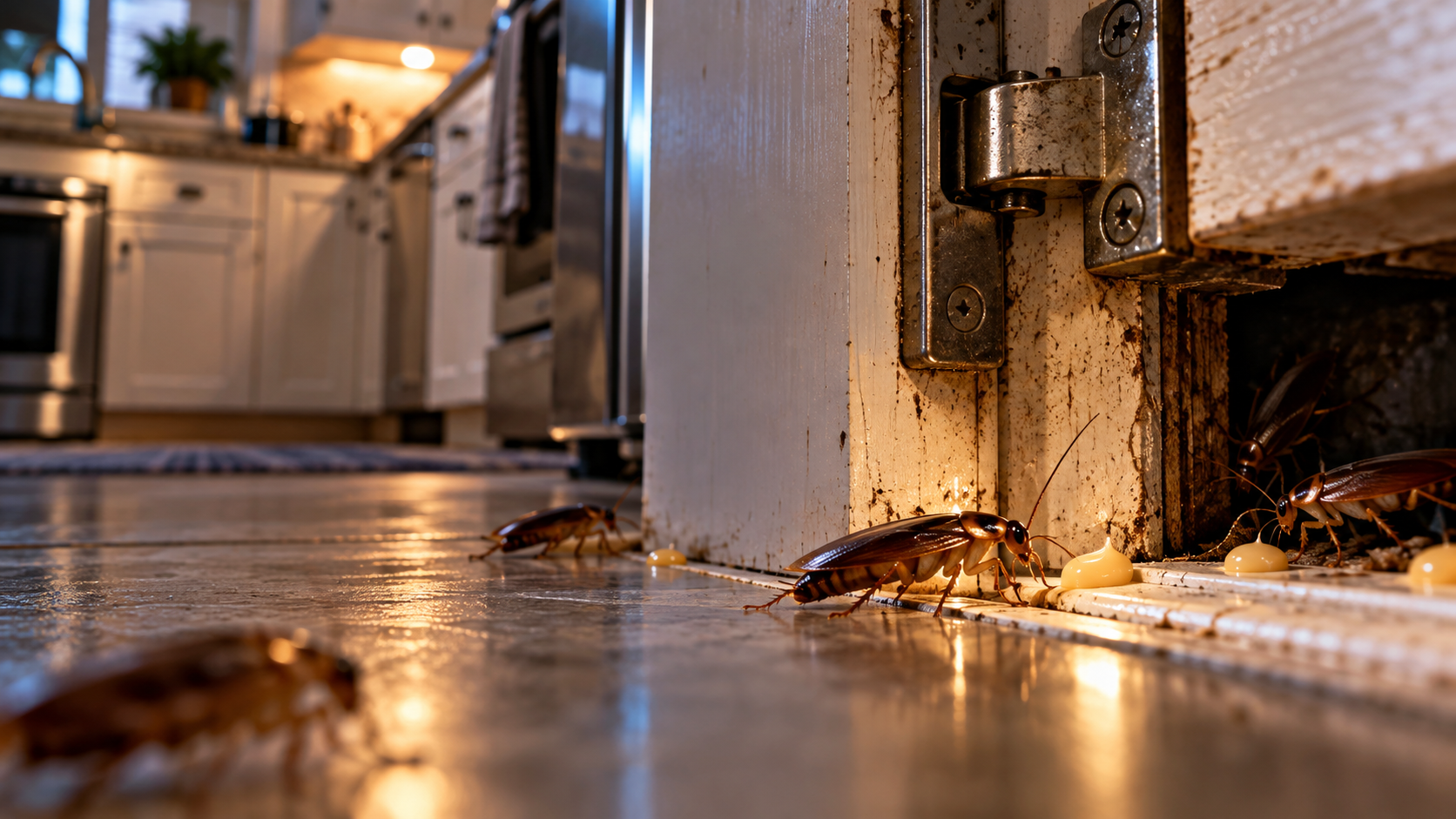
If you are seeing cockroaches repeatedly—particularly small cockroaches around kitchen appliances—professional identification is recommended. Different cockroach species have very different habitats and treatment requirements.
Learn more about our cockroach treatment in Greenville, NC.
8. Control Spiders by Reducing the Insects They Feed On
Spiders often tell you something about the insect population around your home. A structure that consistently attracts flying and crawling insects provides spiders with a dependable food supply.
Regularly remove webs from porches, eaves, garages, windows, exterior fixtures, and other accessible areas. Reduce clutter in garages and storage spaces and seal openings where spiders or their prey can enter.
Exterior lights can also attract insects. Where practical, avoid unnecessary nighttime lighting immediately beside doors and windows.
For recurring problems, see our spider control service in Greenville and Pitt County.
9. Remove Standing Water to Reduce Mosquito Breeding
Mosquito control begins with water management.
After rain, inspect the property for containers or areas that hold water. Pay particular attention to:
- Buckets
- Plant saucers
- Children’s toys
- Tarps
- Birdbaths
- Clogged gutters
- Wheelbarrows
- Outdoor containers
- Discarded tires
- Low areas that remain wet
The EPA recommends eliminating standing water in containers and similar locations as part of mosquito prevention. Their homeowner guidance is available through EPA Smart Pest Control.
If mosquito pressure continues despite source reduction, visit our Mosquito Control in Greenville, NC page.
10. Don’t Forget About Termite Prevention
Termites are different from most nuisance pests because activity may remain concealed for extended periods.
North Carolina’s Eastern subterranean termites live in association with soil and require moisture. NC State Extension identifies conditions such as moisture and cellulose materials around structures as important considerations in termite prevention and monitoring.
Homeowners should watch for:
- Mud tubes on foundations or crawlspace components
- Winged termite swarmers
- Discarded wings
- Damaged or hollowed wood
- Wood or cellulose debris beneath the home
- Wood-to-soil contact
- Persistent crawlspace moisture
NC State provides an extensive homeowner resource on monitoring and managing Eastern subterranean termites.
If you suspect termite activity, visit our Termite Control in Greenville, NC page rather than attempting to treat structural termites without first understanding the extent of the problem.
11. Watch for Fleas Even When the Adult Fleas Seem Gone
Flea problems can be frustrating because only part of the population may be visible at any one time. Eggs, larvae, and pupae may remain in carpets, pet resting areas, cracks, furniture, and protected locations.
Successful control frequently requires cooperation between environmental treatment, cleaning, vacuuming, laundering appropriate materials, and proper veterinary flea control for pets.
For persistent infestations, see our indoor and yard flea control services in Greenville.
12. Inspect Your Home Regularly
A homeowner does not need to be an exterminator to notice early warning signs.
Once every few months—and particularly as seasons change—walk around and through the property looking for conditions that have changed.
Quick Home Pest-Prevention Checklist
- Check exterior doors and door sweeps.
- Inspect screens and vents.
- Look for plumbing leaks.
- Check beneath sinks and appliances.
- Look for ant trails or cockroach evidence.
- Inspect food-storage areas.
- Check the attic and garage for rodent evidence.
- Walk the foundation for gaps or termite tubes.
- Inspect accessible crawlspace areas for excessive moisture.
- Remove standing water from the yard.
- Trim vegetation touching the structure.
- Move wood and debris away from the foundation.
- Check gutters and downspouts.
- Remove excessive cardboard and clutter.
A five-minute inspection today may reveal a small problem before it develops into something more difficult to manage.
When Should You Call a Pest Control Professional?
Some occasional pest sightings can be corrected through sanitation, moisture reduction, exclusion, or simple mechanical control. Other situations deserve professional inspection.
Consider professional help when:
- Pests continue returning after preventive changes.
- You cannot identify the pest.
- You suspect termites or other wood-destroying insects.
- Rodents are active inside the structure.
- Cockroaches continue reproducing indoors.
- An infestation has spread through several rooms.
- You are unsure where pests are entering.
- The problem involves difficult-to-access areas.
- You are considering pesticide treatment but are unsure which product or application site is appropriate.
Professional pest management should be based on identification and inspection rather than simply applying products everywhere. Pesticides must always be used according to their labels. A product labeled for one location or pest should not be assumed appropriate somewhere else.
A Practical Integrated Pest Management Approach
Integrated Pest Management, often shortened to IPM, is not a single pesticide or treatment technique. It is a decision-making process that combines multiple methods.
- Inspect the property.
- Identify the pest correctly.
- Determine why it is present.
- Remove food, water and shelter where practical.
- Seal pest entry points.
- Use mechanical or targeted control methods where appropriate.
- Use pesticides only in accordance with the product label when they are needed.
- Monitor the property afterward.
This approach attacks the conditions supporting pest activity instead of concentrating exclusively on the insects or rodents that happen to be visible today.
Pest Prevention for Greenville and Pitt County Homes
Homes in Greenville, Winterville, Ayden, Farmville, Grifton, and surrounding Pitt County communities can experience pest pressure throughout much of the year. Warm weather, rainfall, vegetation, crawlspaces, moisture, wooded areas, and normal seasonal changes all influence what homeowners may encounter.
A prevention program should therefore be tailored to the property rather than based on a one-size-fits-all checklist. A crawlspace home surrounded by mature trees may have different pest pressures than a newer slab-on-grade home in a more open development.
D & D Pest Control Co. provides professional inspection, treatment, and ongoing pest control services in Greenville and Pitt County for homeowners who need more than basic preventive maintenance.
Frequently Asked Questions About Keeping Pests Out of Your Home
What is the best way to prevent pests from entering my home?
Start by removing the conditions pests need to survive and by sealing entry points. Store food properly, clean spills and crumbs, repair leaks, reduce clutter, maintain gutters and drainage, install or repair door sweeps, seal utility penetrations, and trim vegetation away from the structure. Regular inspection is important because new gaps, moisture problems, or pest evidence can develop over time.
Why do I still have bugs even though my house is clean?
Cleanliness is only one part of pest prevention. Insects may enter because of moisture, exterior pest pressure, structural openings, weather, landscaping, crawlspace conditions, or neighboring properties. A clean home can still provide water, shelter, or access. Identifying the pest and determining where it is entering usually provides better answers than simply increasing cleaning.
Does moisture really attract pests?
Moisture can contribute to many pest problems. Cockroaches, termites, mosquitoes, some ants, and other pests benefit from damp environments or nearby water. Plumbing leaks, crawlspace humidity, clogged gutters, standing water, and poor drainage should therefore be considered during a pest inspection.
How often should I check my home for pest problems?
Homeowners should remain observant throughout the year and perform a more deliberate inspection as seasons change. Properties with previous termite activity, recurring rodents, crawlspace moisture, heavy vegetation, or a history of persistent pests may benefit from more frequent monitoring or professional inspection.
Should I spray pesticides around my house every time I see an insect?
Not necessarily. First identify the organism and determine whether control is actually needed. Integrated Pest Management favors identification, prevention, sanitation, exclusion, monitoring, and targeted control. When a pesticide is appropriate, always read and follow the label, including application-site restrictions, precautions, and directions.
What attracts ants into kitchens?
Ants commonly forage indoors for food and moisture. Sweet substances, grease, crumbs, pet food, water around sinks, and other food residues can sustain activity. Cleaning those sources is important, but recurring trails may indicate an established colony outside or within the structure that requires identification and a colony-focused control strategy.
How can I prevent mice from entering my house?
Inspect the exterior for openings around doors, foundations, utility lines, vents, garages, siding, and crawlspace access points. Reduce outdoor harborage, store food and animal feed securely, and keep garbage covered. If mice are already indoors, trapping or other control measures should be combined with finding and correcting entry points.
Does reducing clutter help prevent pests?
Yes. Clutter creates protected hiding places and makes inspection and treatment more difficult. Cardboard, paper, stored bags, unused items, and crowded storage areas can provide harborage for cockroaches, rodents, spiders, and other pests. Organized storage also makes new pest evidence easier to notice.
How can I reduce mosquitoes around my yard?
Begin by removing water-holding containers and correcting standing-water problems. Check buckets, plant saucers, toys, gutters, tarps, birdbaths, wheelbarrows, discarded containers, and similar locations after rainfall. Reducing breeding habitat is an important component of mosquito management, although properties with heavy mosquito pressure may also require additional control measures.
What should I do if I find termite swarmers or mud tubes?
A termite swarmer or mud tube should be investigated rather than simply sprayed or removed and forgotten. Note the location, preserve a sample if practical, photograph the evidence, and arrange for a professional termite inspection. The objective is to determine whether active termites are associated with the structure and identify conditions that may contribute to the problem.
Need Help With a Recurring Pest Problem?
If ants keep returning, cockroaches are hiding around the kitchen, rodents are moving through the attic or crawlspace, spiders are building webs around entrances, mosquitoes are taking over the yard, or you are concerned about termites, D & D Pest Control Co. can inspect the property and recommend a treatment and prevention plan based on what is actually happening at your home.
We provide pest-control services for homeowners and businesses throughout Greenville, North Carolina and surrounding Pitt County communities.
Call D & D Pest Control Co.: (252) 523-8255
Request Service Online: Contact D & D Pest Control in Greenville, NC
Explore Our Services: Residential & Commercial Pest Control | Termite Control | Rodent Control | Roach Control
For additional D & D Pest Control Co. services throughout Eastern North Carolina, visit our main company website at D & D Pest Control Co..