
Pest problems inside a home rarely begin with the insect or rodent you happen to see. Ants may be following moisture and food sources into a kitchen. Cockroaches may be hiding behind appliances or inside wall voids. Spiders often appear where other insects provide a steady food supply. Rodents may be entering through gaps around utilities, doors, vents, or the foundation. In Greenville and throughout Pitt County, warm temperatures, high humidity, crawlspaces, landscaping, and seasonal weather changes can all contribute to household pest activity.
D & D Pest Control Co. provides professional residential pest control in Greenville, North Carolina for homeowners who want more than a temporary spray. Our approach focuses on identifying the pest, finding the conditions that support the infestation, treating the areas where pests live and travel, and helping reduce the chance of the problem returning.
Whether you are dealing with ants in the kitchen, roaches around appliances, spiders around doors and windows, rodents in an attic, fleas inside the home, or signs of termites around the foundation or crawlspace, we can evaluate the problem and recommend an appropriate treatment plan.
Need residential pest control in Greenville or Pitt County?
Call D & D Pest Control Co. at (252) 523-8255 or request pest control service online.
Home Pest Control Designed for Greenville, North Carolina
Residential pest control works best when the treatment matches the pest and the property. Different insects and rodents have different nesting areas, food sources, moisture requirements, entry points, and seasonal behaviors. That is why successful pest management begins with inspection and identification rather than automatically applying the same treatment everywhere.
Our residential pest-control services may include inspection, pest identification, exterior perimeter treatment, targeted interior applications when appropriate, baiting, crack-and-crevice treatment, monitoring, exclusion recommendations, moisture observations, sanitation recommendations, and recurring pest-prevention service.
The exact approach depends on the pest, the level of activity, the structure, and the conditions around your home.
Common Household Pests We Treat in Greenville & Pitt County
Ants
Ants can enter homes through extremely small openings while searching for food, water, or suitable nesting areas. The ants visible on a countertop may represent only a small portion of the colony.
Successful ant control depends on proper identification because treatment strategies can vary by species. Instead of concentrating only on the ants you see, professional service focuses on trails, entry points, exterior pressure, nesting areas, moisture sources, and conditions that encourage continued activity.
Learn more about our ant control services in Greenville, NC.
Cockroaches
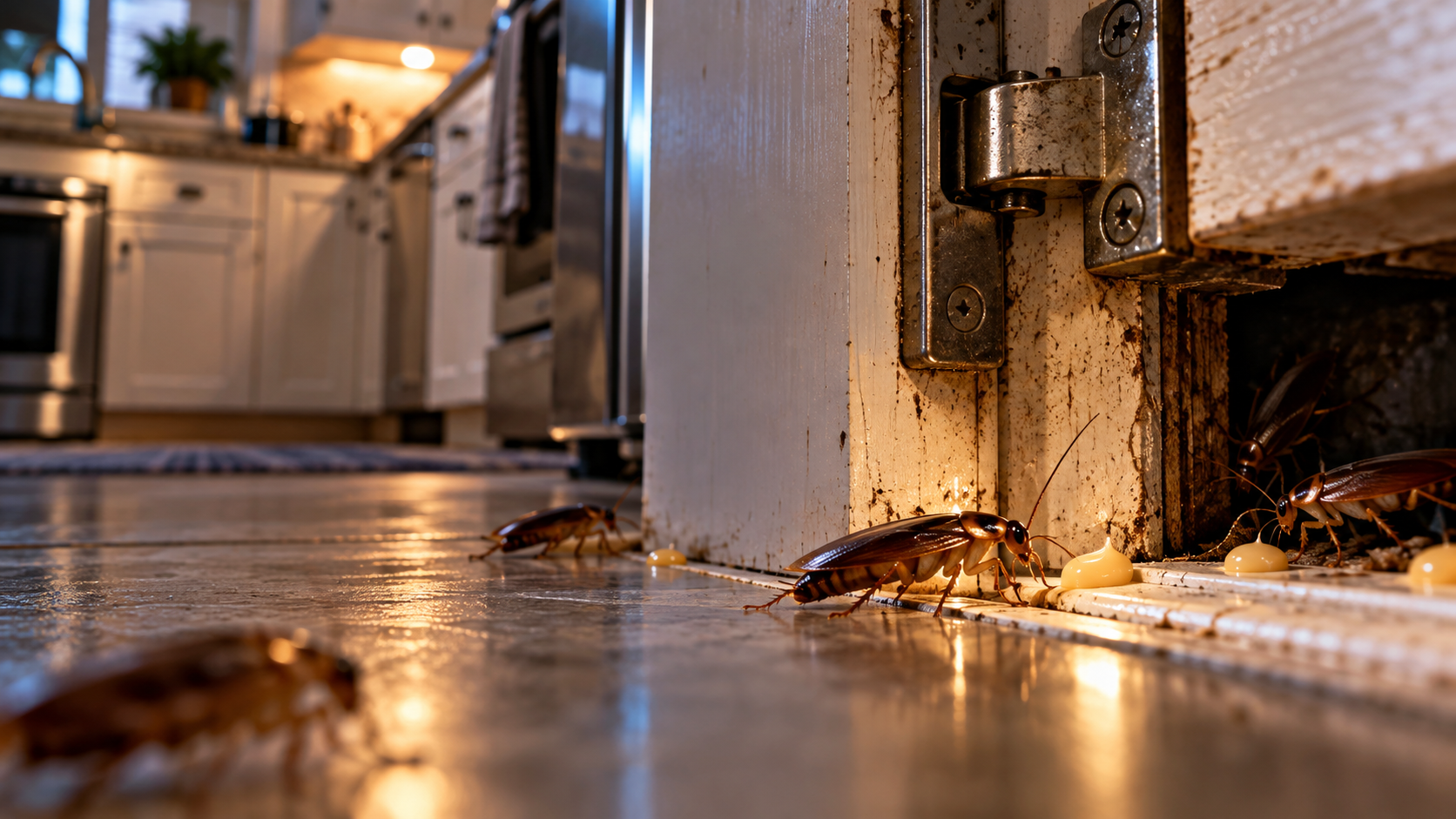
Cockroach problems require more than simply spraying the insects that appear at night. Depending on the species, cockroaches may be associated with kitchens, bathrooms, appliances, plumbing penetrations, crawlspaces, exterior vegetation, drains, cardboard storage, moisture, or food debris.
German cockroach infestations in particular require careful inspection and targeted management because populations can remain hidden in cracks, cabinet areas, appliances, and other protected spaces.
Professional management may involve monitoring, targeted baiting, crack-and-crevice applications, insect growth regulators when appropriate, sanitation recommendations, and follow-up based on activity.
Learn more about cockroach treatment in Greenville.
Spiders
Finding numerous spiders around a home can indicate that other insects are providing an available food source. Webs commonly develop around porch lights, windows, doors, garages, eaves, storage spaces, and other areas where insects gather.
Spider management can include removing accessible webs, reducing insect activity, treating appropriate harborage areas, limiting entry points, managing exterior lighting, and keeping vegetation or stored materials away from the structure.
See our Greenville spider control service for additional information.
Rats & Mice
Rodent control is not simply a matter of placing traps. A lasting solution requires determining where rodents are traveling, what is attracting them, and how they are entering the structure.
Potential entry areas include gaps around utility penetrations, crawlspace vents, exterior doors, garage doors, plumbing lines, damaged screening, roofline openings, and foundation gaps.
Our approach may include inspection, trapping or other appropriate control measures, monitoring, sanitation recommendations, and identifying areas where exclusion or repair may help prevent additional rodents from entering.
Learn more about our rat and mouse control services in Greenville.
Fleas
A flea problem can continue even when relatively few adult fleas are visible because immature stages develop in the surrounding environment. Carpets, rugs, upholstered furniture, pet bedding, floor edges, cracks, shaded yard areas, and locations frequently used by pets can all be involved.
Successful flea management usually requires coordination between treatment of the property and appropriate veterinarian-recommended flea management for pets.
Homeowners may also need to vacuum repeatedly, wash bedding, address pet-resting areas, and follow preparation instructions carefully.
Learn more about house and yard flea control in Greenville, NC.
Termites
Termites require a different approach from ordinary household insects. Eastern subterranean termites live in colonies associated with the soil and may enter structures through areas that are difficult for a homeowner to see.
Crawlspaces, foundation walls, plumbing penetrations, wood-to-soil contact, moisture conditions, and hidden structural areas may require inspection when termite activity is suspected.
Possible warning signs include mud tubes, discarded swarmer wings, termite swarmers indoors, or wood damage. However, termite activity can also be present without obvious visible signs.
For suspected termite activity, visit our termite control page for Greenville and Pitt County.
Why Pests Keep Coming Back
Recurring pest problems often have an underlying cause. Treating visible insects may reduce immediate activity, but continued access to food, water, shelter, or entry points can allow pests to return.
Conditions we may look for during a residential pest evaluation include:
- Plumbing leaks and excess moisture
- Damp crawlspace conditions
- Gaps around doors and windows
- Utility penetrations and foundation openings
- Vegetation touching the structure
- Mulch or organic debris against the foundation
- Food debris or improperly stored food
- Pet food left accessible
- Cardboard and excessive storage clutter
- Standing water around the property
- Exterior lighting that attracts flying insects
- Damaged screens, vents, or door sweeps
Correcting these conditions can be an important part of long-term pest management.
Our Residential Pest Control Process
1. Inspect & Identify the Pest
Effective control starts with knowing what pest is actually present. Different species require different strategies, and treating the wrong pest can waste time while the infestation continues.
We look at the location of activity, likely harborage areas, food and moisture sources, possible entry points, exterior conditions, and other evidence associated with the pest.
2. Determine Why the Pest Is There
We look beyond the individual insect or rodent and evaluate conditions that may be supporting the problem.
Examples include moisture around plumbing, crawlspace humidity, vegetation against the house, gaps in the structure, accessible food, debris, stored cardboard, standing water, or exterior nesting areas.
3. Select an Appropriate Treatment Strategy
Treatment depends on the pest and conditions found during the evaluation. Depending on the situation, this may include targeted baiting, crack-and-crevice applications, exterior perimeter treatment, monitoring devices, mechanical control, exclusion recommendations, or other label-approved pest-management methods.
We avoid treating areas unnecessarily simply because they are part of the house. The goal is to concentrate service where it provides meaningful pest control.
4. Address Entry Points & Conducive Conditions
Pest control is more effective when the property itself becomes less attractive and less accessible to pests.
We may recommend sealing gaps, replacing damaged door sweeps, repairing screens, correcting plumbing leaks, improving sanitation, trimming vegetation, removing debris, reducing standing water, or addressing crawlspace moisture.
5. Monitor & Adjust
Some pest problems can be corrected with a specific treatment. Others benefit from recurring service because pest pressure changes throughout the year.
Monitoring helps determine whether activity is decreasing, whether new entry points have developed, and whether seasonal conditions require an adjustment to the pest-management plan.
Integrated Pest Management for Greenville Homes
Our approach is consistent with the principles of Integrated Pest Management, commonly called IPM. Instead of viewing pesticide application as the only answer, IPM combines inspection, accurate pest identification, prevention, sanitation, exclusion, monitoring, habitat modification, and appropriate treatment methods.
This is especially useful for residential properties because pest activity is often connected to the structure and surrounding environment.
For example:
- An ant problem may require baiting plus correction of moisture or food sources.
- A rodent problem may require trapping plus sealing entry openings.
- Spider activity may improve when the insects they feed on are reduced.
- Roach management may require treatment plus sanitation and moisture correction.
- Mosquito pressure may be reduced by eliminating standing-water breeding sites.
- Termite risk may be influenced by moisture, wood-to-soil contact, drainage, and structural conditions.
This type of comprehensive approach focuses on the reason pests are present—not only the pests visible at the moment of service.
One-Time Pest Control vs. Recurring Pest Protection
Not every Greenville home needs the same service schedule.
One-Time Pest Control
A one-time treatment may be appropriate when there is a specific, isolated pest problem and continued pest pressure is relatively low.
Quarterly Pest Control
Quarterly service can be useful for homeowners who experience recurring ants, spiders, cockroaches, occasional invaders, or other general household pests throughout the year.
More Frequent Service
Higher-pressure situations, active infestations, multi-family properties, or certain pest species may require more frequent monitoring and treatment until activity is controlled.
Learn more about our monthly and quarterly pest control options.
Residential Pest Control for Greenville’s Climate & Homes
Eastern North Carolina provides favorable conditions for many insects for much of the year. Warm weather, humidity, rainfall, vegetation, crawlspaces, wooded lots, drainage conditions, and mild seasonal transitions can all influence pest activity.
Greenville-area homes can also present very different pest-control challenges depending on construction.
A home with a vented crawlspace may have different moisture and pest pressures from a slab-on-grade house. An older property with numerous plumbing and utility penetrations may provide more potential entry points than newer construction. Homes surrounded by mature landscaping may experience different insect pressure from properties in newer subdivisions.
That is why the pest-management plan should fit the structure rather than relying on a one-size-fits-all treatment.
Simple Ways to Help Keep Pests Out of Your Home
Professional pest control works best when homeowners eliminate the conditions pests need to survive.
- Repair leaking faucets, plumbing lines, and exterior water sources.
- Keep gutters and drainage systems functioning properly.
- Seal cracks and openings around doors, windows, pipes, cables, and utilities.
- Install or replace damaged door sweeps and screens.
- Store pantry products and pet food in sealed containers.
- Clean food debris from underneath appliances and cabinets.
- Reduce unnecessary cardboard and indoor clutter.
- Trim shrubs and branches away from siding and rooflines.
- Avoid stacking firewood directly against the house.
- Remove standing water from containers around the yard.
- Inspect crawlspaces periodically for leaks and excess moisture.
- Report recurring pest activity rather than repeatedly covering it with household sprays.
Why Choose D & D Pest Control Co.?
D & D Pest Control Co. has provided professional pest and termite services in Eastern North Carolina since 1994. Our Greenville-area service combines local experience with professional pest identification, targeted treatment, prevention recommendations, and service plans designed around the conditions found at each property.
- Locally focused service for Greenville and Pitt County
- Professional North Carolina pest-control licensing
- Residential and commercial pest-control experience
- General household pest control
- Termite inspections and treatment options
- Rodent management and exclusion recommendations
- Monthly and quarterly pest-control options
- Local knowledge of Eastern North Carolina pest pressure
- Inspection and prevention-focused approach
For information about our company, experience, and services, visit our About D & D Pest Control Co. page.
Residential Pest Control Across Greenville & Pitt County
We provide residential pest-control services throughout Greenville and surrounding Pitt County communities. Our local service area includes:
- Greenville, NC
- Winterville, NC
- Ayden, NC
- Farmville, NC
- Grifton, NC
- Simpson, NC
- Bethel, NC
- Grimesland, NC
- Nearby Pitt County communities
If you are unsure whether your property is within our service area, call (252) 523-8255.
Frequently Asked Questions About Residential Pest Control
How often should a Greenville home receive pest control?
The appropriate frequency depends on the pest, property conditions, surrounding environment, previous infestations, and homeowner preferences. Some isolated problems may only require a specific treatment, while homes with recurring seasonal pest pressure may benefit from quarterly service. Active infestations or high-pressure properties sometimes need more frequent visits initially. We recommend a service schedule after evaluating the property and the pest activity.
What pests are common around Greenville, North Carolina homes?
Greenville-area homeowners commonly encounter ants, cockroaches, spiders, fleas, rodents, mosquitoes, termites, occasional invading insects, and other household pests. Activity varies with the season, weather, moisture, landscaping, construction type, and conditions around the structure. Proper identification is important because treatments that work for one pest may be ineffective for another.
Do I need interior pest control every time?
Not necessarily. Some residential pest problems can be managed primarily by treating exterior pressure points, correcting entry areas, and monitoring the property. If pest activity is occurring indoors, targeted interior treatment may be appropriate. The service should match the problem rather than automatically treating every room during every visit.
Why do bugs keep coming into my house?
Pests enter homes while searching for food, moisture, shelter, nesting areas, or favorable temperatures. Openings around doors, windows, plumbing, cables, utility lines, crawlspaces, vents, and foundations can provide access. Landscaping, standing water, moisture, exterior lighting, food debris, pet food, cardboard, and clutter can also increase pest pressure.
Does moisture around a house contribute to pest problems?
Yes, moisture can contribute to activity from several types of pests. Plumbing leaks, poor drainage, damp crawlspaces, standing water, clogged gutters, and consistently wet landscaping can create favorable conditions for insects and other pests. Moisture does not mean a particular pest will automatically be present, but correcting unnecessary moisture is an important part of many pest-prevention programs.
Should I spray bugs before the pest-control technician arrives?
It is often better to avoid repeatedly spraying over the activity immediately before an inspection. Seeing where pests are traveling can help with identification and locating potential harborages or entry points. Some repellent products may also alter insect movement. If you have already used a pesticide, tell the technician what product was applied and where it was used.
Can pest control help prevent pests rather than just treat an infestation?
Yes. Preventive pest management can include exterior perimeter treatment when appropriate, inspection, monitoring, exclusion recommendations, moisture reduction, sanitation improvements, vegetation management, web removal, and correcting conditions that encourage pest activity. Preventive programs are especially useful for homes that experience recurring seasonal pests.
What should I do before residential pest-control service?
Preparation depends on the pest. In many cases, providing access to areas where activity has been observed is helpful. Avoid moving evidence before inspection when possible, store exposed food, secure pets if requested, and let the technician know where and when pest activity has occurred. Specialized services such as flea, cockroach, or bed bug treatment may require additional preparation instructions.
Are professional pesticides the only part of pest control?
No. Effective pest management may combine monitoring, identification, sanitation, exclusion, moisture correction, habitat modification, mechanical control, baiting, and properly selected pesticide applications when appropriate. This integrated approach helps address both the active infestation and conditions that contribute to future pest activity.
How do I schedule residential pest control in Greenville, NC?
Call D & D Pest Control Co. at (252) 523-8255 or use our online contact form. Tell us what pest you are seeing, where you are noticing activity, and your Greenville or Pitt County location so we can help determine the appropriate next step.
Schedule Residential Pest Control in Greenville, NC
You do not have to guess what is causing a recurring pest problem or continue treating the insects you happen to see while the source remains hidden.
D & D Pest Control Co. provides professional residential pest control for Greenville, Winterville, Ayden, Farmville, Grifton, Simpson, Bethel, Grimesland, and surrounding areas of Pitt County, North Carolina.
We can evaluate the pest problem, identify conditions that may be contributing to the infestation, explain appropriate treatment options, and help you develop a practical plan for protecting your home.
Call D & D Pest Control Co. today:
(252) 523-8255
Request service online:
Contact D & D Pest Control Co.
Serving Greenville and Pitt County, North Carolina.
#ant control #cockroach control #Eastern North Carolina pest control #flea control #Greenville NC exterminator #home pest control #household pests #pest prevention #Pitt County pest control #quarterly pest control #residential pest control Greenville NC #rodent control #spider control #Termite Control
Related Posts
 German Cockroach Gel Baiting: How It Works and Why It’s Effective
 VA & FHA Wood Destroying Insect Reports in Greenville, NC | Pitt County Termite Inspections
 Bed Bugs on the Rise? What Greenville, NC Homeowners Need to Know in 2026